baeke.info, page 6
Enhancing Semantic Search with a Streamlit UI
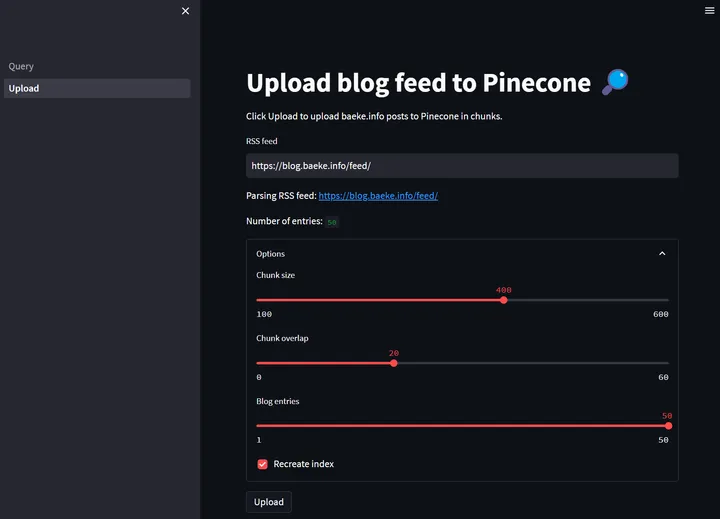
In a previous blog post, we discussed two Python programs, upload_vectors.py and search_vectors.py. These programs were used to create and search vectors, respectively. The upload_vectors.py script created vectors from chunks of a larger text and stored them in Pinecone, while the search_vectors.py script enabled semantic search on the text. In this blog post, we will…
Enhancing Blog Post Search with Chunk-based Embeddings and Pinecone
In this blog post, we’ll show you a different approach to searching through a large database of blog posts. The previous approach involved creating a single embedding for the entire article and storing it in a vector database. The new approach is much more effective, and in this post, we’ll explain why and how to…
Storing and querying for embeddings with Redis
In a previous post, we wrote about using vectorized search and cosine similarity to quickly query a database of blog posts and retrieve the most relevant content to a natural language query. This is achieved using OpenAI’s embeddings API, Pinecone (a vector database), and OpenAI ChatCompletions. For reference, here’s the rough architecture: The steps above…
Pinecone and OpenAI magic: A guide to finding your long lost blog posts with vectorized search and ChatGPT
Searching through a large database of blog posts can be a daunting task, especially if there are thousands of articles. However, using vectorized search and cosine similarity, you can quickly query your blog posts and retrieve the most relevant content. In this blog post, we’ll show you how to query a list of blog posts…
Step-by-Step Guide: How to Build Your Own Chatbot with the ChatGPT API
In this blog post, we will be discussing how to build your own chat bot using the ChatGPT API. It’s worth mentioning that we will be using the OpenAI APIs directly and not the Azure OpenAI APIs, and the code will be written in Python. A crucial aspect of creating a chat bot is maintaining…
Authenticate to Azure Resources with Azure Managed Identities
In this post, we will take a look at managed identities in general and system-assigned managed identity in particular. Managed identities can be used by your code to authenticate to Azure AD resources from Azure compute resources that support it, like virtual machines and containers. But first, let’s look at the other option and why…
AKS Workload Identity Revisited
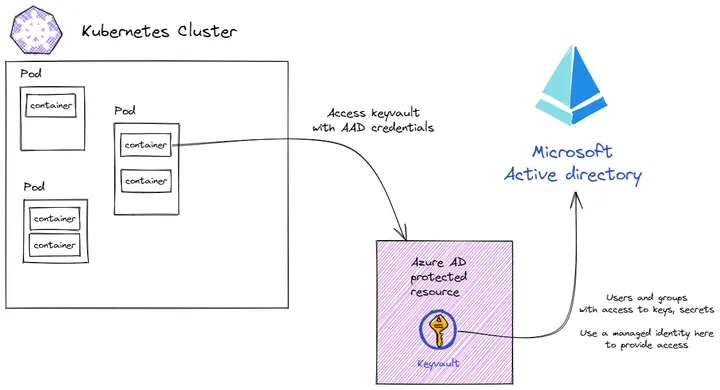
A while ago, I blogged about Workload Identity. Since then, Microsoft simplified the configuration steps and enabled Managed Identity, in addition to app registrations. But first, let’s take a step back. Why do you need something like workload identity in the first place? Take a look at the diagram below. Workloads (deployed in a container…
A quick look at Azure App Configuration and the Python Provider
When developing an application, it is highly likely that it needs to be configured with all sorts of settings. A simple list of key/value pairs is usually all you need. Some of the values can be read by anyone (e.g., a public URL) while some values should be treated as secrets (e.g., a connection string).…
First steps with Crossplane
Image Source: crossplane.io Although Crossplane has been around for a while, I never got around to trying it. Crossplane has many capabilities. However, in this post, I will focus on the following aspects: Installing Crossplane on a Kubernetes cluster (AKS); you can install on a local cluster as well (e.g., k3s, kind, minikube, …) but…
Learn to use the Dapr authorization middleware
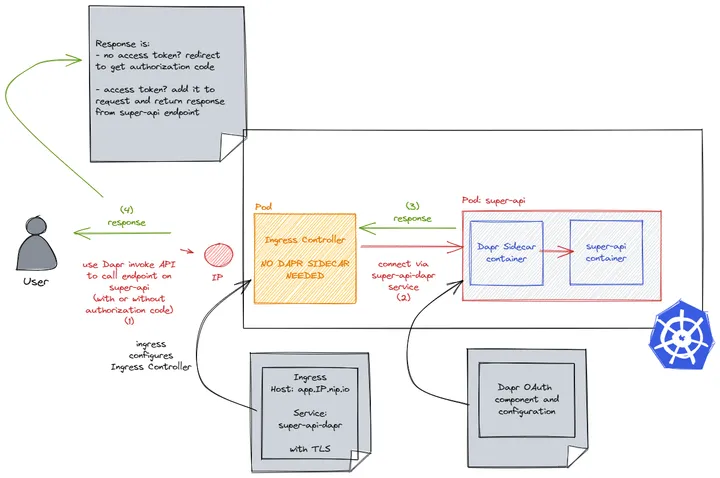
Based on a customer conversation, I decided to look into the Dapr middleware components. More specifically, I wanted to understand how the OAuth 2.0 middleware works that enables the Authorization Code flow. In the Authorization Code flow, an authorization code is a temporary code that a client obtains after being redirected to an authorization URL…