baeke.info, page 2
Using tasks with streaming in Google Agent2Agent (A2A)
In a previous post we created a simple A2A agent that uses synchronous message exchange. An A2A client sends a message and the A2A server, via the Agent Executor, responds with a message. But what if you have a longer running task to perform and you want to inform the client that the task in…
Google’s A2A: taking a closer look
In the previous post, I talked about options to build multi-agent solutions. The last option used Google’s A2A. A2A provides a wrapper around your agent, basically a JSON-RPC API, that standardizes how you talk to your agent. In this post we take a closer look at the basics of A2A with simple synchronous message exchange.…
Building multi-agent solutions: what are your options?
When we meet with customers, the topic of a “multi-agent solution” often comes up. This isn’t surprising. There’s a lot of excitement around their potential to transform business processes, strengthen customer relationships, and more. The first question you have to ask yourself though is this: “Do I really need a multi-agent solution?”. Often, we find…
Building Configurable AI Agents with the OpenAI Agents SDK
In this post, I will demonstrate how to build an AI agent system where agents can collaborate in different ways. The goal is to create agents that can either work independently with their own tools or collaborate with other agents through two distinct patterns: using agents as tools or handing off control to other agents.…
Creating an agent with Hugging Face smolagents and Azure OpenAI
Artificial Intelligence (AI) agents have garnered significant attention, with numerous posts discussing them on platforms such as LinkedIn and X/Twitter. In that sense, this post is not different. Instead of theory though, let’s look at building an agent that has a reasoning loop in a very simple way. Although you can build an agent from…
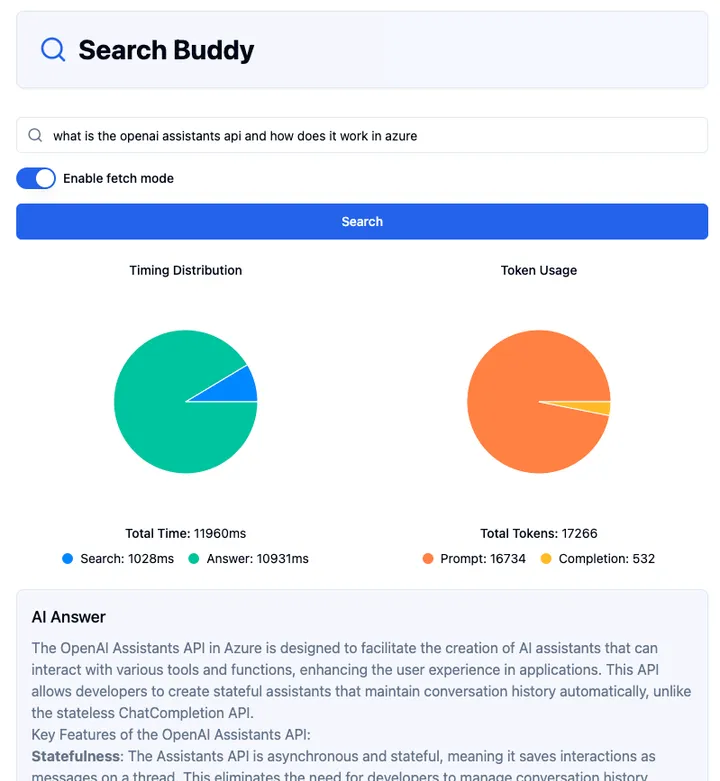
Using Bing Search to ground LLM responses
We often get the question to build an assistant based on the content of a website. These assistants often get implemented in one of two ways: Turn-based chat assistant: user can ask a question and follow-up questions Enhanced search: user asks a questions without the option to ask follow-up questions; this is often used to…
Creating an agent with the Azure AI Agent SDK
Azure AI Agents Service simplifies building intelligent agents by combining advanced AI models, tools, and technology from Microsoft, OpenAI, and partners like Meta and Cohere. It enables integration with knowledge sources such as Bing, SharePoint, and Azure AI Search, and lets agents perform actions across Microsoft and third-party applications using Logic Apps, Azure Functions, and…
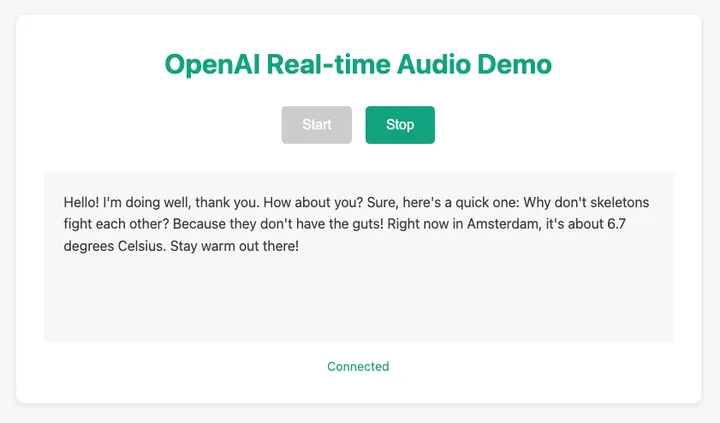
Using WebRTC with the OpenAI Realtime API
In October 2024, OpenAI introduced the Realtime API. It enables developers to integrate low-latency, multimodal conversational experiences into their applications. It supports both text and audio inputs and outputs, facilitating natural speech-to-speech interactions without the need for multiple models. It addresses the following problems: Simplified Integration: Combines speech recognition, language processing, and speech synthesis into…
Using the Azure AI Inference Service
If you are a generative AI developer that works with different LLMs, it can be cumbersome to make sure your code works with your LLM of choice. You might start with Azure OpenAI models and the OpenAI APIs but later decide you want to use a Phi-3 model. What do you do in that case?…
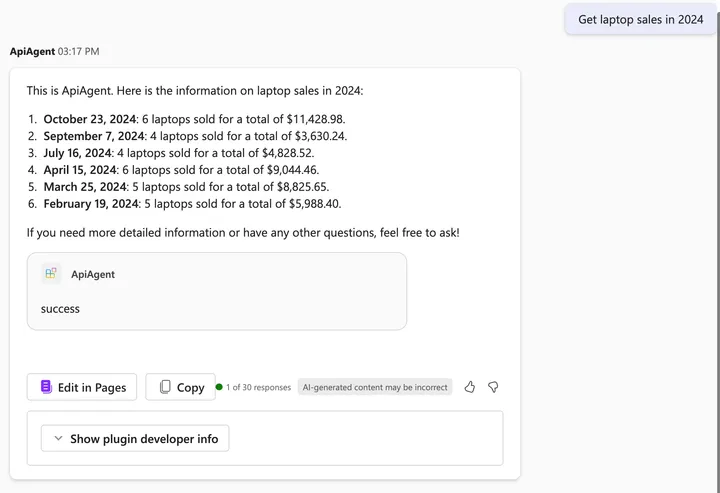
Create a Copilot declarative agent that calls an API with authentication
In a previous post, we looked at creating a Copilot declarative agent. The agent had one custom action that called the JSONPlaceholder API. Check that post for an introduction to what these agents can do. Using a dummy, unauthenticated API is not much fun so let’s take a look at doing the same for a…