Notes of the week: managed agent harnesses, Microsoft's own models and Claude in the EU
Two things stood out in this week’s Notes. Microsoft now runs the agent loop for you in Foundry, with a managed harness, skills and recovery from interruptions. And it keeps widening model choice in two directions at once: its own frontier models from Microsoft AI, and Anthropic’s Claude models moving into the EU Data Boundary for Copilot. A new way to work with AKS rounds out the week.
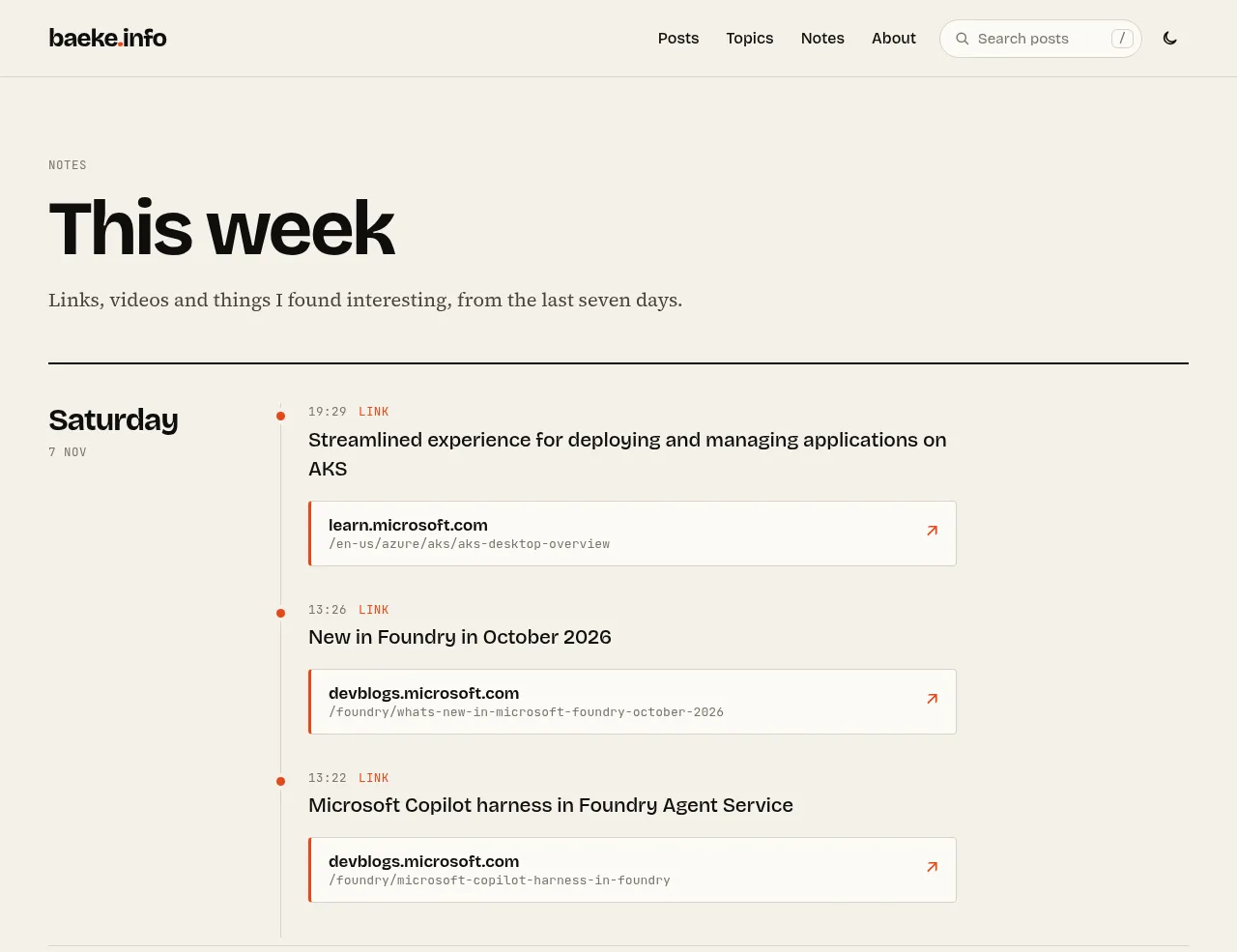
Here are the notes the post is based on, newest first:
The harness becomes a managed service
The Microsoft Copilot harness in Foundry Agent Service went into public preview on October 28. Microsoft runs the agent loop and the sandbox. You bring the knowledge, procedures and tools. The preview has four building blocks:
- reusable skills
- Foundry and MCP tools, with authentication and approvals configured
- execution and delegation: files, code and built-in subagents
- agent definitions you keep in source control
You can define such an agent in azure.yaml with harness: type: microsoft_copilot_preview, add skills as an azure.ai.skill service, and deploy with azd deploy --all. The runtime is free until December 1, 2026. After that, sandbox compute costs $0.0994 per vCPU-hour and $0.0118 per GiB-hour, with model inference and tools billed on top.
⚠️ Important: the harness is in preview, and you pick it when you create the agent. Switching an existing agent to it is not supported yet.
The October roundup for Foundry adds the pieces around it. Long-running resilience for hosted agents is GA: Foundry restarts interrupted work with its original input. Browser Automation went GA on October 19, on a separately provisioned Playwright Workspace. The Decisions API, which returns typed answers to application code, is GA too and works with gpt-6-luna.
⚠️ Important: resilience restarts work from the original input, so your agent has to save its own progress and make sure it doesn’t repeat an external action, like sending the same email twice.
Foundry now offers two levels: prompt agents on the managed harness, and hosted agents when you want your own framework. If you don’t need a custom framework, the harness saves you from building the loop and the sandbox yourself, and skills look like the part you’ll reuse across agents.
Model choice, from both ends
Microsoft AI finished pre-training MAI-Base-2, a mixture-of-experts model with 80 billion active and 2.8 trillion total parameters. Some numbers from the post:
- trained on 16k GB200 GPUs over 38 days in August and September 2026
- a 50T-token training mix, with a knowledge cutoff of March 2026
- 4.2 to 12.3 times the pre-training efficiency of DeepSeek-V4-Pro-Base, by Microsoft’s own measurement
⚠️ Important: MAI-Base-2 is a base model still in post-training. There is no release yet. Microsoft says it will enable licensing of the weights to trusted partners through Foundry.
At the same time, Microsoft is bringing Claude models in Microsoft Copilot into the EU Data Boundary. By the end of 2026, organizations in the EU and EFTA can use Claude across Copilot experiences, including Copilot Cowork, with processing inside the boundary. Customers who already use Claude in Copilot don’t need to do anything. For new ones, the setting is off by default in the EU and EFTA, and admins turn it on for everyone or for selected users and groups in the Microsoft 365 admin center.
If you kept Claude off in Copilot because of where the data gets processed, that reason goes away once this lands.
John Savill’s Microsoft AI update for October 2026 shows how crowded the model list has become in a single month: MAI-Base-2, GPT-6.1 Terra, MAI-Image-2.6, Mistral Large 4, Sonnet 5.5 and a local MAI Code 1.1 Flash. The video also covers the Maia 300 inferencing chip, the Copilot harness, Browser Automation, Agent ID support, Work IQ MCP and the new GitHub Copilot features, so it’s a good 28 minutes if you want the whole month in one go. The Foundry roundup adds that Model Router now picks from 35 models, eight of them added in October, including Claude Opus 5 and Claude Sonnet 5.
Microsoft builds its own frontier models and, at the same time, lets other labs’ models run under the same compliance rules. When you build on Azure, swapping models keeps getting easier, so time spent on evaluations pays off more than betting on one model.
AKS for people who’d rather not write YAML
AKS desktop is an app-focused portal for AKS, built on the open-source Headlamp project. You group deployments, services and configuration in a Project, and deploy, scale and update apps through guided workflows, without writing manifests. It shows logs, metrics and dependency maps in one place, works across multiple clusters, and delegates access per Project with Azure RBAC. You install it with az aks install-desktop (Azure CLI 2.91.0 or later) on Windows, Linux or macOS.
Two features are in preview: natural language troubleshooting with the AKS Agentic CLI agent and the AKS MCP server, and eBPF-based insights with Inspektor Gadget. kubectl and YAML still work alongside it, so platform teams don’t lose anything when app teams use the portal. And even here an agent with an MCP server shows up 😊
Wrapping up
In Foundry, Microsoft now runs the agent loop for you, and the model underneath gets easier to swap, so your own work moves to skills and evaluations. If you spot any errors or have questions, feel free to reach out!
#foundry#agents#copilot#claude#aks
If this post helped you, you can buy me a coffee ☕
Comments
Comments are stored as GitHub Discussions: sign in with GitHub to join in.