Year: 2023 21 posts
Deploy a flow created in Prompt Flow with Docker
Update: this post used an older version of Prompt Flow at the time. It had some issues with building and running the Docker image without issues. In version 1.5.0, it should work fine because the Dockerfile now also installs gcc. In the previous post, we created a flow with Prompt Flow in Visual Studio Code.…
Writing your first flow with Prompt Flow in Visual Studio Code
In this blog post, we will create a flow with Prompt Flow in Visual Studio Code. Prompt Flow is a suite of development tools to build LLM-based AI applications. It tries to cover the end-to-end development cycle, including prototyping, testing and deployment to production. In Prompt Flow, you create flows. Flows link LLMs (large language…
Building an Azure AI Search index with a custom skill
In this post, we will take a look at building an Azure AI Search index with a custom skill. We will use the Azure AI Search Python SDK to do the following: create a search index: a search index contains content to be searched create a data source: a datasource tells an Azure AI Search…
Finding images with text and image queries with the help of GPT-4 Vision
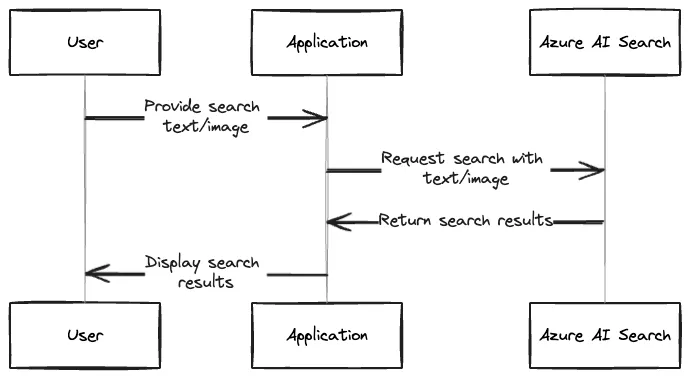
With the gpt-4-vision-preview model available at OpenAI, it was time to build something with it. I decided to use it as part of a quick solution that can search for images with text, or by providing a similar image. We will do the following: Describe a collection of images. To generate the description, GPT-4 Vision…
Using Integrated Vectorization in Azure AI Search
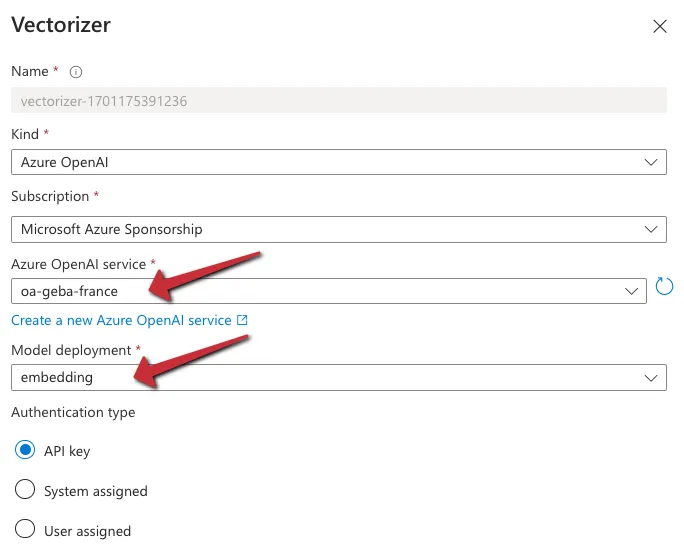
The vector search capability of Azure AI Search became generally available mid November 2023. With that release, the developer is responsible for creating embeddings and storing them in a vector field in the index. However, Microsoft also released integrated vectorization in preview. Integrated vectorization is useful in two ways: You can define a vectorizer in…
Creating a custom GPT to query any knowledge base with actions
A while ago, OpenAI introduced GPTs. A GPT is a custom version of ChatGPT that combine instructions, extra knowledge, and any combination of skills. In this tutorial, we are going to create a custom GPT that can answer questions about articles on this blog. In order to achieve that, we will do the following: create…
Trying the OpenAI Assistants API
If you have ever tried to build an AI assistant, you know that is not a simple task. In almost all cases, your assistant needs access to external knowledge such as documents or APIs. You might even want to provide your assistant a code sandbox to solve user queries with code. When your assistant is…
Working with Recipes and Gateways in Microsoft’s Radius
In a previous post, we looked at the basics of deploying a multi-container app that uses Dapr with Radius. In this post, we will add two things: a recipe that deploys Redis a gateway: to make the app available to the outside world Find the full code and app.bicep in the following branch: https://github.com/gbaeke/raddemo/tree/radius-step1. Recipes…
Giving Microsoft’s Radius a spin
Microsoft recently announced Radius. As stated in their inaugural blog post, it is “a tool to describe, deploy, and manage your entire application”. With Radius, you describe your application in a bicep file. This can include containers, databases, the connections between those and much more. Radius is an open-source solution started from within Microsoft. The…
Using Azure Database for PostgreSQL as a vector store
When we build LLM applications, there is always a recurring question: “What vector store will we use?”. In Azure, there are several native solutions. Some of them were discussed in previous posts. Azure Cognitive Search: supports vector search but also hybrid search with semantic reranking as discussed here Azure Redis Cache Enterprise: check my blog…
Use Azure OpenAI Add your data vector search from code
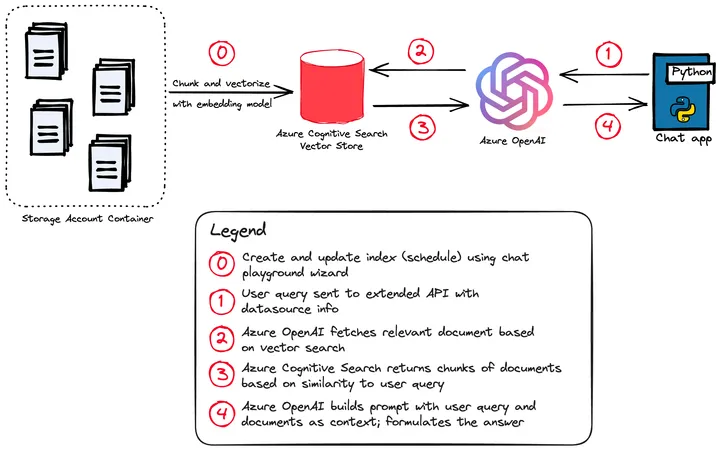
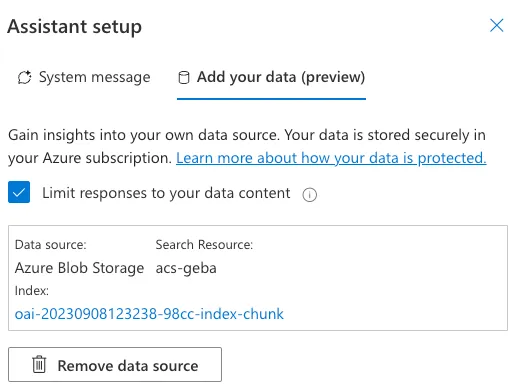
In the previous post, we looked at using Azure OpenAI Add your data from the Azure OpenAI Chat Playground. It is an easy-to-follow wizard to add documents to a storage account and start asking questions about them. From the playground, you can deploy a chat app to an Azure web app and you are good…
Improvements in Azure OpenAI Add your data
In a previous post, I talked about the Add your data feature in the Azure OpenAI Chat playground. Recently, there have been some updates to this feature, including vector search. Let’s take a look at the updated experience and focus on vector search. Starting point I have some PDF documents in a storage account container.…
Use the Azure Add your data feature from code
In a previous post, we looked at Azure Add your data (preview) that can be configured from the Azure OpenAI Chat playground. In a couple of steps, you can point to or upload files of a supported file type (PDF, Word, …) and create an Azure Cognitive Search index. That index can subsequently be queried…
Building a chatbot in Azure that works with your data
When I talk to customers about Azure OpenAI, I am often asked how to build a chatbot that uses your own data in the simplest way possible while still allowing for some customization. In Azure, there are a few solutions. We will look at one of the solutions in this post. Note: don’t feel like…
Semantic Kernel Planner 101
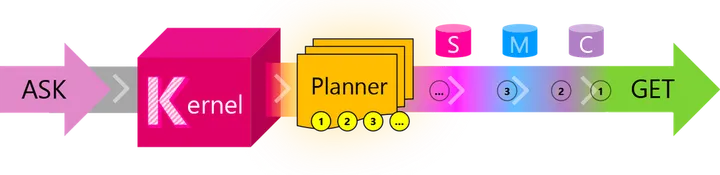
Introduction If you are a developer who wants to build AI-first apps with natural language processing and large language models, you might be interested in Semantic Kernel (SK), a lightweight and open-source SDK that aims to simplify the integration of AI with conventional programming languages. SK is part of the CoPilot Stack and Microsoft is…
Enhancing Semantic Search with a Streamlit UI
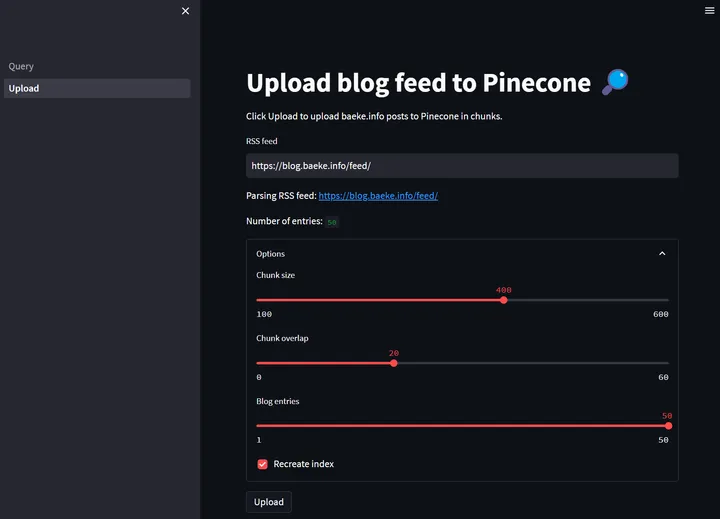
In a previous blog post, we discussed two Python programs, upload_vectors.py and search_vectors.py. These programs were used to create and search vectors, respectively. The upload_vectors.py script created vectors from chunks of a larger text and stored them in Pinecone, while the search_vectors.py script enabled semantic search on the text. In this blog post, we will…
Enhancing Blog Post Search with Chunk-based Embeddings and Pinecone
In this blog post, we’ll show you a different approach to searching through a large database of blog posts. The previous approach involved creating a single embedding for the entire article and storing it in a vector database. The new approach is much more effective, and in this post, we’ll explain why and how to…
Storing and querying for embeddings with Redis
In a previous post, we wrote about using vectorized search and cosine similarity to quickly query a database of blog posts and retrieve the most relevant content to a natural language query. This is achieved using OpenAI’s embeddings API, Pinecone (a vector database), and OpenAI ChatCompletions. For reference, here’s the rough architecture: The steps above…
Pinecone and OpenAI magic: A guide to finding your long lost blog posts with vectorized search and ChatGPT
Searching through a large database of blog posts can be a daunting task, especially if there are thousands of articles. However, using vectorized search and cosine similarity, you can quickly query your blog posts and retrieve the most relevant content. In this blog post, we’ll show you how to query a list of blog posts…
Step-by-Step Guide: How to Build Your Own Chatbot with the ChatGPT API
In this blog post, we will be discussing how to build your own chat bot using the ChatGPT API. It’s worth mentioning that we will be using the OpenAI APIs directly and not the Azure OpenAI APIs, and the code will be written in Python. A crucial aspect of creating a chat bot is maintaining…
Authenticate to Azure Resources with Azure Managed Identities
In this post, we will take a look at managed identities in general and system-assigned managed identity in particular. Managed identities can be used by your code to authenticate to Azure AD resources from Azure compute resources that support it, like virtual machines and containers. But first, let’s look at the other option and why…