Creating presentations with Microsoft Agent Framework and GAMMA API

Introduction

Imagine automating the creation of professional presentations through a coordinated series of intelligent agents. In this blog post, we’ll explore how to build a workflow that combines research, outline generation, content creation, and design, all orchestrated through the Microsoft Agent Framework.

We’ll build a practical example that generates presentations using:

  • Azure OpenAI Responses API for agent creation
  • Microsoft Agent Framework Workflows for orchestration
  • Tavily Search API for concurrent web research
  • GAMMA API for stunning presentation generation (In October 2025, this API was in beta)

By the end, you’ll understand how to leverage these tools to create end-to-end workflows that tackle complex, multi-step tasks.


What is Microsoft Agent Framework?

The Microsoft Agent Framework is a new, modern framework for building intelligent automation systems powered by AI agents. It enables you to create agents and workflows that blend AI reasoning with structured business processes.

Agents vs. Workflows: Understanding the Difference

Before diving into workflows, it’s important to understand how agents and workflows complement each other:

  • AI Agents are LLM-powered systems that make dynamic decisions based on context. They have access to tools and can reason through problems, but the steps they take are determined by the model at runtime.
Agent (from Microsoft Learn)
  • Workflows, on the other hand, are predefined sequences of operations with explicit control flow. They define exactly how data flows from one step to the next. Workflows can contain agents as components, orchestrating them alongside other executors and services.
Workflow (from Microsoft Learn)

Think of it this way:

  • An agent is like an expert consultant who decides how to solve a problem
  • workflow is like a project manager who coordinates multiple specialists in a structured process

The framework provides the tools to do both and to combine them in interesting ways.


Creating an Agent with Azure OpenAI Responses API

Let’s start by understanding how to create individual agents before we orchestrate them into workflows.

The Azure OpenAI Responses API is Azure’s version of the OpenAI Responses API . It’s the successor to the chat completion APIs and supports structured outputs, tool calling, stateful interactions and hosted tools.

Note: Azure OpenAI Responses API does not support the native web search tool. We will use Tavily to support web searches.

Here’s how to create a simple agent in Agent Framework, based on the Responses API:

import asyncio
import os
from dotenv import load_dotenv
from agent_framework.azure import AzureOpenAIResponsesClient
from azure.identity import AzureCliCredential

# Load environment variables from .env
load_dotenv()

async def main():
    # Create a client
    client = AzureOpenAIResponsesClient(
        endpoint=os.getenv("AZURE_OPENAI_ENDPOINT"),
        api_key=os.getenv("AZURE_OPENAI_API_KEY"),
        deployment_name=os.getenv("AZURE_OPENAI_DEPLOYMENT", "gpt-4o")
    )
    
    # Create an agent
    agent = client.create_agent(
        name="OutlineAgent",
        instructions="Based on the user's request, you create an outline for a presentation.",
    )
    
    # Run the agent
    result = await agent.run("Create an outline for a presentation about Python")
    print(result.text)

if __name__ == "__main__":
    asyncio.run(main())

Note: this is just one type of agent you can create with Agent Framework. Some of the other supported types are chat completion agents and Azure AI Foundry Agents. See Microsoft Learn for more information. We could have used these agents as well.

Agents with Function Tools

Agents become truly useful when equipped with function tools—custom Python functions that agents can call to accomplish tasks. In Agent Framework, you can use the optional @ai_function decorator to provide a meaningful description to the LLM using the function. An alternative is to use a docstring. The framework will automatically convert the Python functions to tools the LLM understands.

from agent_framework import ai_function
from typing import Annotated
from pydantic import Field

@ai_function(
    name="search_web",
    description="Search the web for information"
)
async def search_web(
    queries: Annotated[list[str], Field(description="List of search queries")]
) -> str:
    # Implementation here
    pass

Once defined, you pass these tools to your agent:

agent = client.create_agent(
    name="ResearchAgent",
    instructions="You research and create content for slides.",
    tools=[search_web]  # Register the tool
)

Now the agent can autonomously decide to call search_web when it needs information! In the agent instructions, you can tell the agent how and when to use the tool if needed.

In the example discussed further in this post, both the outline agent and research agent use the search function to build the slide content.

Structured Output with Pydantic

For predictable, structured responses, the framework supports structured output with Pydantic models:

from pydantic import BaseModel, Field
from typing import List, Annotated

class OutlineResponse(BaseModel):
    title: str
    number_of_slides: Annotated[int, Field(default=5)]
    slide_titles: List[str]
    audience: Annotated[str, Field(default="general")]

agent = client.create_agent(
    name="OutlineAgent",
    instructions="Create a presentation outline.",
    response_format=OutlineResponse  # Enforce this structure
)

The agent’s response will automatically be validated and parsed as an OutlineResponse object: type-safe and predictable. This feature is supported by the underlying Responses API with its support for structured outputs.

We use structured outputs extensively in the example code discussed below.


Understanding Workflows: Orchestrating Agents at Scale

Now that we understand agents, let’s see how to compose them into workflows.

A workflow is built from four key components:

  1. Executors – The individual processing nodes (agents, custom logic, integrations)
  2. Edges – Connections defining data flow between executors
  3. Workflows – The orchestrator that manages execution and routing
  4. Events – Real-time observability into execution

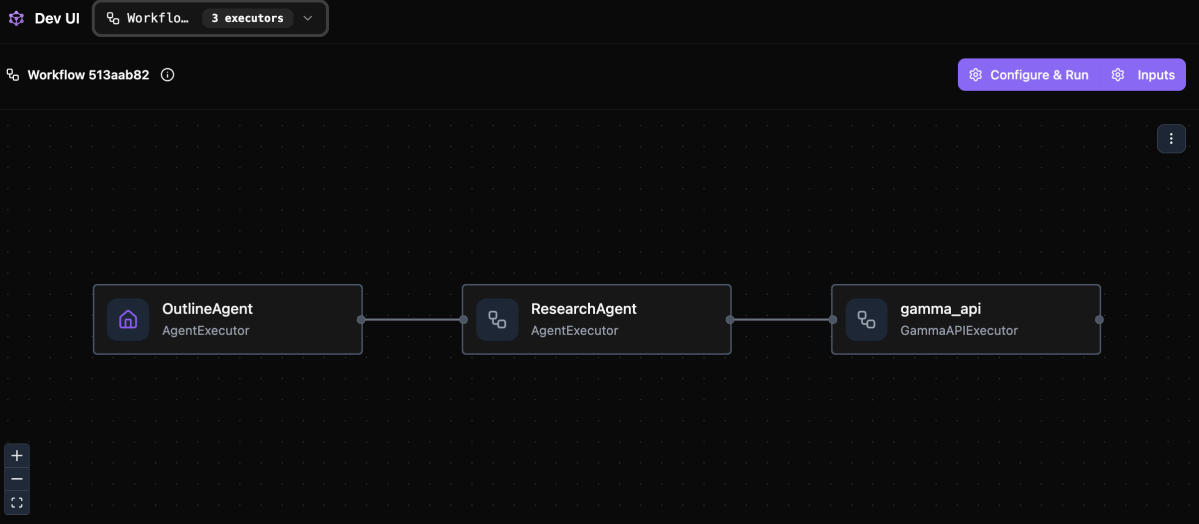
Agent Framework can visualize workflows in different ways. One option is to use the DevUI:

DevUI with a sequential workflow ready to run

To run the workflow, simply click Configure & Run and provide your input. The steps in the workflow will light up when they are doing work.

For more information about Dev UI see the Agent Framework repository on GitHub.

Building a Workflow with WorkflowBuilder

After defining the executors, you use WorkflowBuilder to build a workflow:

from agent_framework import WorkflowBuilder

workflow = (
    WorkflowBuilder()
    .set_start_executor(outline_agent)          # First step
    .add_edge(outline_agent, research_agent)    # Data flows here
    .add_edge(research_agent, gamma_executor)   # Final step
    .build()
)

# serve workflow with Dev UI
serve(entities=[workflow], port=8093, auto_open=True)

This creates a linear, sequential flow where:

  1. Input → outline_agent produces an outline
  2. Outline → research_agent researches and creates slide content
  3. Slide content → gamma_executor generates the presentation

Note that the first two steps are simply Azure Responses API agents (AgentExecutors). The third step is a custom executor inheriting from the Executor class.

The workflow is served with Dev UI, which results in a browser opening the Dev UI interface as shown in the screenshot above.

Input and Output Between Nodes

Understanding data flow in the workflow is crucial. Each executor (agents or custom) receives input and must send output to the next executor. Below is a custom executor created from a Python function. You can also create executors from a Python class:

@executor(id="some executor id")
async def handle_input(self, message: str, ctx: WorkflowContext) -> None:
    # Process the input
    result = do_some_work(message)
    
    # Send output to next executor(s)
    ctx.send_message(result)

For agents specifically, they receive messages and produce AgentExecutorResponse objects automatically. You do not have to write code that sends the output of an agent to the next node.

Custom Executors for Complex Logic

Sometimes you need logic beyond agent reasoning. Custom executors handle this. Below is a class-based executor versus a fuction-based executor above:

from agent_framework import Executor, handler, WorkflowContext

class GammaAPIExecutor(Executor):
    def __init__(self, id: str = "gamma_api"):
        super().__init__(id=id)

    @handler
    async def call_gamma_api(
        self, response: AgentExecutorResponse, ctx: WorkflowContext
    ) -> None:
        # Extract data from agent response
        slide_content = response.agent_run_response.text
        
        # Call external API
        api_response = requests.post(
            "https://api.gamma.app/generations",
            json=payload
        )
        
        # Yield final output
        await ctx.yield_output({"status": "success", "pdf_url": pdf_url})

Custom executors are perfect for:

  • Calling external APIs
  • Data transformation and validation
  • Conditional routing logic
  • Long-running operations like polling

We will use a custom executor to call the GAMMA API to create a presentation based on the output of the previous agent nodes.

Using Sequential Orchestration

The simplest types of workflow process tasks one after another, each building on the previous result. This is ideal for pipelines where each step depends on prior outputs.

Input → Agent A → Agent B → Agent C → Output

Use sequential when:

  • Steps have dependencies
  • Later steps need data from earlier ones
  • You want controlled, predictable execution flow

Other types of workflow orchestration are discussed on Microsoft Learn. We will use a sequential workflow in the example below.


The Presentation Workflow in Action

Now let’s see how all these concepts come together in our actual implementation.

Architecture Overview

Our workflow follows this flow:

Step 1: Outline Agent

This is an agent with a web search tool. The agent generates a search query relevant to the user input and decides on a presentation title and a list of slide titles:

outline_agent = AzureOpenAIResponsesClient(
    endpoint=endpoint,
    api_key=api_key,
    deployment_name=deployment_name
).create_agent(
    name="OutlineAgent",
    instructions="""
        Based on the user's request, you create an outline for a presentation.
        Before you generate the outline, use the 'search_web' tool to research 
        the topic thoroughly with ONE query.
        Base the outline on the research findings.
    """,
    tools=[search_web],
    response_format=OutlineResponse,
    middleware=[logging_function_middleware]
)

  • Input: User’s presentation request sent to the agent as a user message

Processing:

  • Calls search_web to research the topic
  • Generates a structured outline with title and slide titles

OutputOutlineResponse object with titlenumber_of_slidesslide_titles, and audience

If the user specifies the number of slides and audience, this will be reflected in the reponses.

Note: this agent uses middleware to log the use of the search_web tool.

Step 2: Research Agent

The research agent takes the presentation title and slides from the previous step and does research on the web for each slide:

research_agent = AzureOpenAIResponsesClient(
    endpoint=endpoint,
    api_key=api_key,
    deployment_name=deployment_name
).create_agent(
    name="ResearchAgent",
    instructions="""
        You research and create content for slides.
        Generate one web search query for each slide title.
        Keep in mind the target audience when generating queries.
        Next, use the 'search_web' tool ONCE passing in the queries all at once.

        Use the result from the queries to generate content for each slide.
        Content for slides should be limited to 100 words max with three main bullet points.
    """,
    tools=[search_web],
    response_format=ResearchResponse,
    middleware=[logging_function_middleware]
)

Input: The OutlineResponse from the outline agent is automatically sent as a user message. This message will contain the JSON output from the previous step.

Processing:

  • Generates one search queries per slide
  • Calls search_web with all queries concurrently (crucial for performance!)
  • Creates 100-word slide content with bullet points. It’s best to keep slide content concise for best results.

OutputResearchResponse object with slide content for each slide

Why Concurrency Matters: The Search Tool

To speed up research, the search_web function uses AsyncTavilyClient for concurrent searching:

from tavily import AsyncTavilyClient

tavily_client = AsyncTavilyClient(TAVILY_API_KEY)

@ai_function(
    name="search_web",
    description="Search the web for multiple topics using Tavily"
)
async def search_web(
    queries: Annotated[list[str], Field(description="List of search queries")]
) -> str:
    logger.info(f"SEARCH - Performing web searches for {len(queries)} queries")
    
    async def _search_single_query(query: str) -> dict:
        try:
            logger.info(f'SEARCH - "{query}" - Searching')
            # AsyncTavilyClient.search() is awaitable
            response = await tavily_client.search(
                query=query,
                search_depth="advanced",
                max_results=5,
            )
            return {"query": query, "results": response.get("results", [])}
        except Exception as e:
            logger.error(f'SEARCH - "{query}" - {str(e)}')
            return {"query": query, "results": [], "error": str(e)}
    
    # Run all searches concurrently!
    tasks = [_search_single_query(query) for query in queries]
    search_results = await asyncio.gather(*tasks)
    
    # Aggregate and return
    aggregated = {r["query"]: r["results"] for r in search_results}
    return json.dumps({"results": aggregated})

Key insight: By using AsyncTavilyClient instead of the synchronous TavilyClient, we enable concurrent execution. All queries run in parallel, dramatically reducing total execution time.

To learn more about Tavily, check their website. They have a generous free tier which I almost exhausted creating this example! 😊

Step 3: Custom Gamma Executor

Step three does not need an agent. It uses the output of the agents to call the GAMMA API:

class GammaAPIExecutor(Executor):
    @handler
    async def call_gamma_api(
        self, response: AgentExecutorResponse, ctx: WorkflowContext
    ) -> None:
        # Extract slide content
        slide_content = response.agent_run_response.text
        response_json = json.loads(slide_content)
        
        logger.info(f'GAMMA - "{title}" - Slides: {number_of_slides}')
        
        # Call Gamma API
        api_response = requests.post(
            f"{GAMMA_API_BASE_URL}/generations",
            headers=headers,
            json=payload,
            timeout=30,
        )
        
        generation_id = data.get("id") or data.get("generationId")
        logger.info(f'GAMMA - POST /generations {api_response.status_code}')
        
        # Poll for completion
        completed_data = await self._poll_for_completion(generation_id)
        
        # Download PDF
        pdf_path = self._download_pdf(completed_data.get("exportUrl"))
        
        logger.info(f'GAMMA - Presentation completed')
        await ctx.yield_output(f"PDF saved to: {pdf_path}")

Input: The ResearchResponse from the research agent (slide content)

Processing:

  • Calls GAMMA API to generate presentation
  • Polls for completion (generation is asynchronous)
  • Downloads resulting PDF
  • The presentation is also available in Gamma for easy editing:
Presentation available in Gamma after creation with the workflow

Output: Success message with PDF path and presentation in Gamma.


Running the example

The workflow code is on GitHub in the gamma folder: https://github.com/gbaeke/maf/tree/main/gamma

In that folder, check https://github.com/gbaeke/maf/blob/main/gamma/SETUP_GUIDE.md for setup instructions.

End-to-end authorization with Entra ID and MCP

Building an MCP server is really easy. Almost every language and framework has MCP support these days, both from a client and server perspective. For example: FastMCP (Python, Typescript), csharp-sdk and many more!

However, in an enterprise scenario where users use a web-based conversational agent that uses tools on an MCP server, those tools might need to connect to back-end systems using the identity of the user. Take a look at the following example:

A couple of things are important here:

  • The user logs on to the app and requests an access token that is valid for the MCP Server; you need app registrations in Entra ID to make this work
  • The MCP Server verifies that this token is from Entra ID and contains the correct audience; we will use FastMCP in Python which has some built-in functionality for token validation
  • When the user asks the agent a question that requires Azure AI Search, the agent decides to make a tool call; the tool on the MCP server does the actual work
  • The tool needs access to the token (there’s a helper in FastMCP for that); next it converts the token to a token valid for Azure AI Search
  • The tool can now perform a search in Azure AI Search using new functionality discussed here

⚠️ MCP is actually not that important here. This technique which uses OAuth 2.0 and OBO flows in Entra ID is a well established pattern that’s been in use for ages!

🧑‍💻 Full source code here: https://github.com/gbaeke/mcp-obo

Let’s get started and get this working!

Entra ID App Registrations

In this case, we will create two registrations: one for the front-end and one for the back-end, the MCP Server. Note that the front-end here will be a command-line app that uses a device flow to authenticate. It uses a simple token cache to prevent having to log on time and again.

Front-end app registration

We will create this in the Azure Portal. I assume you have some knowledge of this so I will not provide detailed step-by-step instructions:

  • Go to App Registrations
  • Create a new registration, FastMCP Auth Web
  • In Authentication, ensure you enable Allow public client flows

You will need the client ID of this app registration in the MCP client we will build later.

Back-end app registration

This is for the MCP server and needs more settings:

  • Create a new registration, FastMCP Auth API
  • In Certificates and secrets, add a secret. We will need this to implement the on-behalf-of flow to obtain the Azure AI Search token
  • In Expose an API, set the Application ID URI to https://CLIENTIDOFAPP. I also added a scope, execute. In addition, add the front-end app client Id to the list of Authorized client applications:
Expose API of MCP app registration

In order to exchange a token for this service for Azure AI Search, we also need to add API permissions:

Permissions for Azure Cognitive, ehhm, AI Search

When you add the above permission, find it in APIs my organization uses:

MCP Client

We can now write an MCP client that calls the MCP server with an access token for the API we created above. As noted before, this will be a command-line app written in Python.

The code simply uses MSAL to initiate a device flow. It also uses a token cache to avoid repeated logins. The code can be found here.

Once we have a token, we can construct an MCP client (with FastMCP) as follows:

token = get_jwt_token()

headers["Authorization"] = f"Bearer {token}"

transport_url = "http://localhost:8000/mcp/"

transport = StreamableHttpTransport(
        url=transport_url,
        headers=headers
    )

client = MCPClient(transport=transport)

This code ensures that requests to the MCP server have an Authorization header that contains the bearer token acquired by get_jwt_token(). The MCP server will validate this token strictly.

The code to connect to the MCP server looks like this:

try:
    logger.info("Connecting to the MCP server...")
    
    # Use the client as an async context manager
    async with client:
        # List available tools on the server
        tools = await client.list_tools()
        logger.info(f"Found {len(tools)} tools on the server")
        
        # Call search tool
        logger.info("Calling search tool...")
        search_result = await client.call_tool("get_documents", {"query": "*"})
        logger.info(f"Search Result: {search_result.structured_content}")
        documents = search_result.structured_content.get("documents", [])
        if documents:
            logger.info("Documents found:")
            for doc in documents:
                name = doc.get("name", "Unnamed Document")
                logger.info(f"  - {name}")
        else:
            logger.info("No documents found.")
    
except Exception as e:
    logger.error(f"Error connecting to MCP server: {e}")

Note that there is no AI Agent involved here. We simply call the tool directly. In my case the document search only lists three documents out of five in total because I only have access to those three. We will look at the MCP server code to see how this is implemented next.

⚠️ Example code of the client is here: https://github.com/gbaeke/mcp-obo/blob/main/mcp_client.py

MCP Server

We will write an MCP server that uses the streamable-http transport on port 8000. The URL to connect to from the client then becomes http://localhost:8000/mcp. That was the URL used by the MCP client above.

The server has one tool: get_documents that takes a query (string) as parameter. By default, the query is set to * which returns all documents. The tool does the following:

  • Obtains the access token with the get_access_token() helper function from FastMCP
  • Exchanges the token for a token with scope https://search.azure.com/.default
  • Creates a SearchClient for Azure AI Search that includes the AI Search endpoint, index name and credential. Note that that credential has nothing to do with the token obtained above. It’s simply a key provided by Azure AI Search to perform searches. The token is used in the actual search request to filter the results.
  • Performs the search, passing in the token via the x_ms_query_source_authorization parameter. You need to use this version of the Azure AI Search Python library: azure-search-documents==11.6.0b12

Here is the code:

# Get the access token from the context
access_token: AccessToken = get_access_token()
original_token = access_token.token

# Exchange token for Microsoft Search token
logger.info("Exchanging token for Microsoft Search access")
search_result = await exchange_token(original_token, scope="https://search.azure.com/.default")
if not search_result["success"]:
    return {"error": "Could not retrieve documents due to token exchange failure."}
else:
    logger.info("Search token exchange successful")
    search_token = search_result["access_token"]
    search_client = SearchClient(endpoint="https://srch-geba.search.windows.net", index_name="document-permissions-push-idx", credential=AzureKeyCredential(os.getenv("AZURE_SEARCH_KEY")))
    results = search_client.search(search_text="*", x_ms_query_source_authorization=search_token, select="name,oid,group", order_by="id asc")
    documents = [
        {
        "name": result.get("name"),
        "oid": result.get("oid"),
        "group": result.get("group")
        }
        for result in results
    ]
    return {"documents": documents}

The most important work is done by the exchange_token() function. It obtains an access token for Azure AI Search that contains the oid (object id) of the user.

Here’s that function:

async def exchange_token(original_token: str, scope: str = "https://graph.microsoft.com/.default") -> dict:
    
    obo_url = f"https://login.microsoftonline.com/{TENANT_ID}/oauth2/v2.0/token"
    
    data = {
        "grant_type": "urn:ietf:params:oauth:grant-type:jwt-bearer",
        "client_id": CLIENT_ID,
        "client_secret": CLIENT_SECRET,
        "assertion": original_token,
        "scope": scope,
        "requested_token_use": "on_behalf_of"
    }
    
    try:
        response = requests.post(obo_url, data=data)
        
        if response.status_code == 200:
            token_data = response.json()
            return {
                "success": True,
                "access_token": token_data["access_token"],
                "expires_in": token_data.get("expires_in"),
                "token_type": token_data.get("token_type"),
                "scope_used": scope,
                "method": "OBO"
            }
        else:
            return {
                "success": False,
                "error": response.text,
                "status_code": response.status_code,
                "scope_attempted": scope,
                "method": "OBO"
            }
    except Exception as e:
        return {
            "success": False,
            "error": str(e),
            "method": "OBO"
        }

Above, the core is in the call to the obo_url which presents the original token to obtain a new one. This will only work if the API permissions are correct on the FastMCP Auth API app registration. When the call is successful, we return a dictionary that contains the access token in the access_token key.

Full code of the server: https://github.com/gbaeke/mcp-obo/blob/main/mcp/main.py

You have now seen the entire flow from client login to calling a method (tool) on the MCP server to connecting to Azure AI Search downstream via an on-behalf-of flow.

But wait! How do we create the Azure AI Search index with support for the permission filter? Let’s take look…

Azure AI Search Configuration

When you want to use permission filtering with the x_ms_query_source_authorization parameter, do the following:

  • Create the index with support for permission filtering
  • Your index needs fields like oid (object Ids) and group (group object Ids) with the correct permission filter option
  • When you add documents to an index, for instance with the push APIs, you need to populate the oid and group fields with identifiers of users and groups that have access
  • Perform a search with the x_ms_query_source_authorization like show below:
results = search_client.search(
search_text="*",
x_ms_query_source_authorization=token_to_use,
select="name,oid,group",
order_by="id asc"
)

Above, token_to_use is the access token for Azure AI Search!

On GitHub, check this notebook from Microsoft to create and populate the index with your own user’s oid. You will need an Azure Subscription with an Azure AI Search instance. The free tier will do. If you use VS Code, use the Jupyter extension to run this notebook.

At the time of this writing, this feature was in preview. Ensure you use the correct version of the AI Search library for Python: azure-search-documents==11.6.0b12.

Wrapping up

I hope this post gives you some ideas on how to build agents that use MCP tools with end-to-end user authentication and authorization. This is just one possible approach. Authorization in the MCP specification has evolved significantly in early 2025 and works somewhat differently.

For most enterprise scenarios where you control both code and configuration (such as with Entra ID), bearer authentication with OBO is often sufficient.

Also consider whether you need MCP at all. If you aren’t sharing tools across multiple agents or projects, a simple API might be enough. For even less overhead, you can embed the tool code directly in your agent and run everything in the same process. Simple and effective.

If you spot any errors or have questions, feel free to reach out!

Deploying a multi-agent solution with MCP and A2A to Azure Container Apps

In previous posts, we discussed multi-agent scenarios, how A2A servers work (here and here) and how to deploy the infrastructure to host a multi-agent application on Azure with Azure Container Apps and AI Foundry.

In this post, we will take a look at deploying the different components of the solution as containers in Azure Container Apps. This is what we will build:

Multi-agent solution with MCP and A2A

There are four main components:

ComponentDescription
Conversation AgentPresents a chat interface to the user. Built with Chainlit and Semantic Kernel. Uses an OpenAI model. This could be switched to an Azure OpenAI model easily.

The agent uses two tools, rag and web, hosted by the MCP server.
MCP Tools ServerMCP server built with Python FastMCP. It exposes two tools, web and rag. The tools use an A2A client to interact with the A2A servers for the web and rag agents.

Not exposed to the Internet. Used to demonstrate MCP and A2A together. We could have called the A2A servers directly from the conversation agent without MCP.
A2A Server for Foundry Agent (does RAG)This agent uses an Azure AI Foundry Agent with a hosted file-based RAG tool to provide answers about Contoso products.

Not exposed to the Internet. Communicates privately with the Azure AI Foundry project.
A2A Server for OpenAI Agent (does web searches)This agent uses an OpenAI Agent SDK agent with the hosted web search tool.

Not exposed to the Internet. Communicates over the Internet with the OpenAI backend. This could easily be replaced with an Azure AI Foundry Agent that uses Bing Search. As this is an example about A2A, using a different technology makes more sense. 😊

Before delving into the four different components, it is important to know that the mcp, web and rag containers do not use their internal ingresses to communicate over TLS. That means that the mcp container for example, will talk to the web container using http://ca-web instead of something like https://ca-web.internal.ACA_environment_default_domain.

There is something to be said for using messaging to facilitate communication between agents. They are a form of microservices after all. In this example however, all communication is synchronous and uses HTTP.

This is a technical example that could be implemented in a single in-process agent with two tools. However, the emphasis is on multi-agent communication across process boundaries with Google’s Agent2Agent protocol.

Let’s gets started with the Conversation Agent!

Conversation Agent

The conversation agent maintains a conversation with the end user and keeps track of chat history. The agent, written in Semantic Kernel, has two tools:

  • web-search: uses the OpenAI Agent A2A server to search the web via OpenAI’s hosted web search tool
  • rag-search: uses the Azure AI Foundry A2A server to search for Contoso projects via a hosted RAG tool

The user interface to the agent is provided by Chainlit:

Chainlit UI

Above, I asked for information about a project. The agent is configured to use the rag-search tool to find project information. Under the hood, an A2A Server that wraps an Azure AI Foundry Agent is used to obtain this information. Via a filter, Chainlit supports visualizing when tools are called as can be seen at the top of the screen. It basically has hooks into the kernel object that gets created by Semantic Kernel.

The code for this Chainlit-hosted agent is on GitHub. The code in main.py uses an environment variable, MCP_SERVER_URL, that contains the address of the MCP server. As discussed above this will be http://containername/mcp (e.g., http://ca-mcp/mcp).

Following the typical Semantic Kernel approach, a kernel is created . Here is a snippet of code:

# Create the Semantic Kernel
        kernel = Kernel()
        
        # Add AI service to kernel
        ai_service = OpenAIChatCompletion(ai_model_id="gpt-4o")
        kernel.add_service(ai_service)
        logger.debug("Kernel and AI service initialized successfully")
        
        # Add MCP tools plugin to kernel (uses global client)
        tools_plugin = MCPToolsPlugin()
        kernel.add_plugin(tools_plugin, plugin_name="mcp_tools")
        logger.debug("MCP tools plugin added to kernel")

Note that we are not using Semantic Kernel’s built-in support for remote MCP servers that use streamable HTTP. Instead, we create a plugin via the MCPToolsPlugin class. That class defines two kernel functions, rag_search and web_search. In such a function, you can do what you want. I did not have to use MCP and could have called the A2A servers directly using the A2A client.

In our functions, we do use the MCP client from FastMCP to call the appropriate tool on the MCP server. The call to the A2A servers is implemented in the MCP server’s tools.

⚠️ This approach was chosen to illustrate that even if your framework does not natively support MCP, under the hood this is always LLM function calling. Kernel functions in Semantic Kernel are simply an abstraction on top of function calling. If you use Semantic Kernel’s native support for MCP, the tools on the MCP server would automatically be created as kernel functions. This native support requires much less code.

Now that we have the conversation agent up and running with Chainlit and Semantic Kernel, let’s look at the MCP server.

MCP Server

The conversation agent uses an MCP client (from the FastMCP library) to call tools hosted by the MCP server. This illustrates the separation of tool implementation from agent implementation.

The MCP server is implemented in main.py. In its most basic form, an MCP server with a few tools is really simple. This MCP server just defines two tools: a web tool and a rag tool.

The web tool looks like this:

@mcp.tool()
async def web_tool(query: str) -> str:
    """
    Perform a web search for the given query.
    
    Args:
        query: The search query to perform
        
    Returns:
        Search results as a string
    """
    logger.info(f"Web tool called with query: {query}")
    logger.info(f"Using web A2A agent at: {WEB_A2A_BASE_URL}")
    
    try:
        return await _send_a2a_message(query, WEB_A2A_BASE_URL)
    except Exception as e:
        logger.error(f"Error performing web search: {e}")
        return f"Error performing web search: {str(e)}"

This tool only does one thing: send a message to the A2A server on the address in WEB_A2A_BASE_URL. In Azure Container Apps, this URL is http://ca-web. The rag tool is implemented in a similar way. You can check the code of the _send_a2a_message function on GitHub.

⚠️ The addresses of the A2A servers are supplied to the mcp container app via environment variables WEB_A2A_BASE_URL and RAG_A2A_BASE_URL.

We now have the following implemented:

conversation --tool call--> MCP Server --run tool--> A2A Server

All traffic is synchronous and over http (not https)! Everything depends on the correct tool call being made by the conversation agent and the agents in the A2A servers. The rest is just plumbing! No magic! 😊

A2A Servers

You can check my earlier posts about A2A servers for background information:

It is important to note that the A2A server (rag) uses Azure AI Foundry. To authenticate to AI Foundry, we need to use a managed identity.

The rag container needs the following environment variables:

  • RAG_A2A_BASE_URL: required to set the correct url in the agent card
  • INTERNAL_PORT: port to run on (e.g., 80)
  • FOUNDRY_PROJECT: url to the Foundry project (e.g., https://FOUNDRY-RESOURCE.services.ai.azure.com/api/projects/FOUNDRY-PROJECT
  • ASSISTANT_ID: id of the agent you want to use; needs to exist in Foundry project
  • CLIENT_ID: the client id of the user assigned managed identity; this identity is created in the Bicep script; a role is assigned as well

During deployment of the container apps, a managed identity (that has the client id above) is assigned to the container. In the A2A server code that contains the code to talk to Foundry, this identity is used as follows:

if client_id:
            logger.info(f"Using ManagedIdentityCredential with client ID: {client_id}")
            credential = ManagedIdentityCredential(client_id=client_id)
        else:
            logger.info("Using DefaultAzureCredential")
            credential = DefaultAzureCredential()

This allows for the use of the Azure CLI identity when the rag agent is running on you local machine. Full code is in Agent_Executor.py.

⚠️ If you run the rag A2A server on your local machine, ensure you allow your IP address in the firewall settings of the Azure AI Foundry resource.

Full code for the A2A servers:

Deployment

To make it easy to deploy the containers to the Azure Container Apps environment (discussed in previous post), use the following script: https://github.com/gbaeke/multi_agent_aca/blob/main/deploy_containers.sh

At the top of the script, change the variables to match your environment:

ACR_NAME="SHORT_ACR_NAME"
ACR_URL="SHORT_ACR_NAME.azurecr.io"
RESOURCE_GROUP="RESOURCE_GROUP"
CONTAINER_APP_ENV="CONTAINER_APP_ENV_NAME"
MANAGED_IDENTITY="MANAGED_IDENTITY_NAME"

To deploy, simply run deploy_containers.sh --to-build conversation,mcp,web,rag. This does the following:

  • Builds and pushes the four containers using an ACR Task (no local Docker required)
  • Deploys the four containers with appropriate secrets and environment variables; serets are read from a .env file

Ensure that you have this .env in the same folder with the following values:

OPENAI_API_KEY="your_openai_api_key_here"
# Replace with your actual OpenAI API key

FOUNDRY_PROJECT="your_foundry_project_url"
# The URL of the Foundry project endpoint you're connecting to
# Find it in the properties of the AI Foundry project

ASSISTANT_ID="your_assistant_id_here"
# The unique ID of the agent you're referencing

This should deploy the four containers as shown below:

conversation, mcp, web and rag containers

Now grab the ingress URL (aka Application Url) of the conversation container:

Application URL (ingress URL) to the conversation app

Paste that URL in your browser. Hopefully the Chainlit UI is shown. If not, check the following:

  • Chainlit container has the MCP_SERVER_URL set to http://ca-mcp/mcp and also has you OpenAI key in OPENAI_API_KEY
  • MCP container has the WEB_A2A_BASE_URL and RAG_A2A_BASE_URL url set to http://ca-web and http://ca-rag
  • Web container has WEB_A2A_BASE_URL set to http://ca-web and also has an OPENAI_API_KEY
  • Rag container has RAG_A2A_BASE_URL set to http://ca-rag and has environment variables set to use the Azure AI Foundry agent; also check the managed identity of the container has access rights to AI Foundry

Normally these should all be set by both the Bicep and the container deployment script.

Wrapping Up

If you’ve made it this far and tried to implement this yourself, you’ve likely realized how much effort it takes to get everything up and running. About 99% of the work is infrastructure and plumbing; only 1% is actual agent code. In more complex agentic applications, the ratio may shift slightly, but infrastructure will still dominate the effort.

We have not even touched on things like logging, metrics, tracing the end-to-end communication path, load balancing, saving agent state and much, much more.

This brings me back to a key point from an earlier post:


If you can build your multi-agent solution in-process, or use an agent PaaS like Azure AI Foundry, do it.


Only choose the approach I described above when no other viable option exists or when you’re building larger solutions where multiple teams develop agents that must coexist within the same system.

Building multi-agent solutions: what are your options?

When we meet with customers, the topic of a “multi-agent solution” often comes up. This isn’t surprising. There’s a lot of excitement around their potential to transform business processes, strengthen customer relationships, and more.

The first question you have to ask yourself though is this: “Do I really need a multi-agent solution?”. Often, we find that a single agent with a range of tools or a workflow is sufficient. If that’s the case, always go for that option!

On the other hand, if you do need a multi-agent solution, there are several things to think about. Suppose you want to build something like this:

Generic multi-agent setup

Users interact with a main agent that maintains the conversation with the user. When the user asks about a project, a RAG agent retrieves project information. If the user also asks to research or explain the technologies used in the project, the web agent is used to retrieve information from the Internet.

⚠️ If I were to follow my own advice, this would be a single agent with tools. There is no need for multiple agents here. However, let’s use this as an example because it’s easy to reason about.

What are some of your options to build this? The list below is not exhaustive but contains common patterns:

  • Choose a framework (or use the lower-level SDKs) and run everything in the same process
  • Choose an Agent PaaS like Azure AI Foundry Agents: the agents can be defined in the platform; they run independently and can be linked together using the connected agents feature
  • Create the agents in your framework of choice, run them as independent processes and establish a method of communication between these agents; in this post, we will use Google’s A2A (Agent-to-Agent) as an example. Other options are ACP (Agent Communication Protocol, IBM) or “roll your own”

Let’s look at these three in a bit more detail.

In-Process Agents

Running multiple agents in the same process and have them work together is relatively easy. Let’s look at how to do this with OpenAI Agents SDK. Other frameworks use similar approaches.

Multi-agent in-process using the OpenAI Agents SDK

Above, all agents are written using the OpenAI Agents SDK. In code, you first define the RAG and Web Agent as agents with their own tools. In the OpenAI Agents SDK, both the RAG tool and the web search tool are hosted tools provided by OpenAI. See https://openai.github.io/openai-agents-python/tools/ for more information about the FileSearchTool and the WebSearchTool.

Next, the Conversation Agent gets created using the same approach. This time however, two tools are addedd: the RAG Agent Tool and the Web Agent Tool. These tools get called by the Conversation Agent based on their description. This simply is tool calling in action where each tool calls another agent and returns the agent result. The way these agents interact with each other is hidden from you. The SDK simply takes care of it for you.

You can find an example of this in my agent_config GitHub repo. The sample code below shows how this works:

rag_agent = create_agent_from_config("rag")
web_agent = create_agent_from_config("web")

agent_as_tools = {
    "rag": {
        "agent": rag_agent,
        "name": "rag",
        "description": "Provides information about projects"
    },
    "web": {
        "agent": web_agent,
        "name": "web",
        "description": "Gets information about technologies"
    }
}

conversation_agent = create_agent_from_config("conversation", agent_as_tools)

result = await Runner.run(conversation_agent, user_question)

Note that I am using a helper function here that creates an agent from a configuration file that contains the agent instructions, model and tools. Check my previous post for more information. The repo used in this post uses slightly different agents but the concept is the same.

Creating a multi-agent solution in a single process, using a framework that supports calling other agents as tools, is relatively straightforward. However, what if you want to use the RAG Agent in other agents or workflows? In other words, you want reusability! Let’s see how to do this with the other approaches.

Using a Agent PaaS: Azure AI Foundry Agents

Azure AI Foundry Agents is a PaaS solution to create and run agents with enterprise-level features such as isolated networking. After creating an Azure AI Foundry resource and project, you can define agents in the portal:

Agents defined in Azure AI Foundry

⚠️ You can also create these agents from code (e.g., Foundry SDK or Semantic Kernel) which gives you extra flexibility in agent design.

The web and rag agents have their own tools, including hosted tools provided by Foundry, and can run on their own. This is already an improvement compared to the previous approach: agents can be reused from other agents, workflows or any other application.

Azure AI Foundry allows you to connect agents to each other. This uses the same approach as in the OpenAI Agents SDK: agents as tools. Below, the Conversation Agent is connected to the other two agents:

Connected Agents for the Conversation Agent

The configuration of a connected agent is shown below and has a name and description:

It all fits together like in the diagram below:

Multi-agent with Azure AI Foundry

As discussed above, each agent is a standalone entity. You can interact with these agents using the AI Foundry Agents protocol, which is an evolution of the OpenAI Assistant’s protocol. You can read more about it here. In short, to talk to an agent you do the following:

  • Create the agent in code or reference an existing agent (e.g., our conversation agent)
  • Create a thread
  • Put a message on the thread (e.g., the user’s question or a question from another agent via the connected agents principle)
  • Run the thread on the agent and grab the response

Below is an example in Python:

from azure.ai.projects import AIProjectClient
from azure.identity import DefaultAzureCredential
from azure.ai.agents.models import ListSortOrder

project = AIProjectClient(
    credential=DefaultAzureCredential(),
    endpoint="https://YOUR_FOUNDRY_ENDPOINT")

agent = project.agents.get_agent("YOUR_ASSISTANT_ID")

thread = project.agents.threads.create()
print(f"Created thread, ID: {thread.id}")

message = project.agents.messages.create(
    thread_id=thread.id,
    role="user",
    content="What tech is used in some of Contoso's projects?"
)

run = project.agents.runs.create_and_process(
    thread_id=thread.id,
    agent_id=agent.id)

if run.status == "failed":
    print(f"Run failed: {run.last_error}")
else:
    messages = project.agents.messages.list(thread_id=thread.id, order=ListSortOrder.ASCENDING)

    for message in messages:
        if message.text_messages:
            print(f"{message.role}: {message.text_messages[-1].text.value}")

The connected agents feature uses the same protocol under the hood. Like in the OpenAI Agents SDK, this is hidden from you.

When you mainly use Azure AI Foundry agents, there is no direct need for agent-to-agent protocols like A2A or ACP. In fact, even when you have an agent that is not created in Azure AI Foundry, you can simply create a tool in that agent. The tool can then use the thread/message/run approach to get a response from the agent hosted in Foundry. This can all run isolated in your own network if you wish.

You could argue that the protocol used by Azure AI Foundry is not an industry standard. You cannot simply use this protocol in combination with other frameworks. Unless you use something like https://pypi.org/project/llamphouse/, a project written by colleagues of mine which is protocol compatible with the OpenAI Assistants API.

Let’s take a look at the third approach which uses a protocol that aspires to be a standard and can be used together with any agent framework: Google’s A2A.

Using Google’s A2A in a multi-agent solution

The basic idea of Google’s A2A is the creation of a standard protocol for agent-to-agent communication. Without going into the details of A2A, that’s for another post, the solution looks like this:

A multi-agent solution with A2A

A2A allows you to wrap any agent, written in any framework, in a standard JSON-RPC API. With an A2A client, you can send messages to the API which uses an Agent Executor around your actual agent. Your agent provides the response and a message is sent back to the client.

Above, there are two A2A-based agents:

  • The RAG Agent uses Azure AI Foundry and its built-in vector store tool
  • The Web Agent uses OpenAI Agent SDK and its hosted web search tool

The conversation agent can be written in any framework as long as you define tools for that agent that use the A2A protocol (via an A2A client) to send messages to the other agents. This again is agents as tools in action.

To illustrate this standards-based approach, let’s use the A2A Inspector to send a message to the RAG Agent. As long as your agent has an A2A wrapper, this inspector will be able to talk to it. First, we connect to the agent to get its agent card:

Connecting to the RAG Agent with A2A

The agent card is defined in code and contains information about what the agent can do via skills. Once connected, I can send a message to the agent using the A2A protocol:

Sending a message which results in a task

The message that got sent was the following (JSON-RPC):

{
  "id": "msg-1752245905034-georiakp8",
  "jsonrpc": "2.0",
  "method": "message/send",
  "params": {
    "configuration": {
      "acceptedOutputModes": [
        "text/plain",
        "video/mp4"
      ]
    },
    "message": {
      "contextId": "27effaaa-98af-44c4-b15f-10d682fd6496",
      "kind": "message",
      "messageId": "60f95a30-535a-454f-8a8d-31f52d7957b5",
      "parts": [
        {
          "kind": "text",
          "text": "What is project Astro (I might have the name wrong though)"
        }
      ],
      "role": "user"
    }
  }
}

This was the response:

{
  "artifacts": [
    {
      "artifactId": "d912666b-f9ff-4fa6-8899-b656adf9f09c",
      "parts": [
        {
          "kind": "text",
          "text": "Project \"Astro\" appears to refer to \"Astro Events,\" which is a web platform designed for users to discover, share, and RSVP to astronomy-related events worldwide. The platform includes features such as interactive sky maps, event notifications, and a community forum for both amateur and professional astronomers. If you were thinking about astronomy or space-related projects, this may be the correct project you had in mind【4:0†astro_events.md】. If you're thinking of something else, let me know!"
        }
      ]
    }
  ],
  "contextId": "27effaaa-98af-44c4-b15f-10d682fd6496",
  "history": [
    HISTORY HERE
  ],
  "id": "d5af08b3-93a0-40ec-8236-4269c1ed866d",
  "kind": "task",
  "status": {
    "state": "completed",
    "timestamp": "2025-07-11T14:58:38.029960+00:00"
  },
  "validation_errors": []
}

If you are building complex multi-agent solutions, where multiple teams write their agents in different frameworks and development languages, establishing communication standards pays off in the long run.

However, this approach is much more complex than the other two approaches. We have only scratched the surface of A2A here and have not touched on the following aspects:

  • How to handle authentication?
  • How to handle long running tasks?
  • How to scale your agents to multiple instances and how to preserve state?
  • How to handle logging and tracing across agent boundaries?

⚠️ Most of the above is simply software engineering and has not much to do with LLM-based agents!

Conclusion

In this article, we discussed three approaches to building a multi-agent solution

ApproachComplexityReusabilityStandardizationBest For
In-processLowLimitedNoSimple, single-team use cases
Agent PaaSMediumGoodNo (vendor-specific)Org-wide, moderate complexity
A2A ProtocolHighExcellentYesCross-team, cross-platform needs

When you really need a multi-agent solution, I strongly believe that the first two approaches should cover 90% of use cases.

In complex cases, the last option can be considered although it should not be underestimated. To make this option a bit more clear, a follow-up article will discuss how to create and connect agents with A2A in more detail.

Building Configurable AI Agents with the OpenAI Agents SDK

In this post, I will demonstrate how to build an AI agent system where agents can collaborate in different ways. The goal is to create agents that can either work independently with their own tools or collaborate with other agents through two distinct patterns: using agents as tools or handing off control to other agents.

In this post, I work directly with OpenAI models. You can also use Azure OpenAI if you want, but there are some caveats. Check this guide on using Azure OpenAI and potentially APIM with the OpenAI Agents SDK for more details.

All code can be found in this repo: https://github.com/gbaeke/agent_config. Not all code is shown in this post so be sure to check the repo.

Agent Factory and Configuration System

The core of this system is an agent factory that creates agents from JSON configurations stored either on the filesystem or in Redis. The factory reads configuration files that define:

  • Agent name and instructions
  • Which AI model to use (e.g., gpt-4o-mini)
  • Available tools from a centralized tool registry
  • Validation against a JSON schema

For example, a weather agent configuration looks like:

{
    "name": "Weather Agent",
    "instructions": "You are a helpful assistant for weather questions...",
    "model": "gpt-4o-mini",
    "tools": ["get_current_weather", "get_current_temperature", "get_seven_day_forecast"]
}

The agent factory validates each configuration against a schema and can load configurations from either JSON files in the configs/ directory or from Redis when USE_REDIS=True (env var). This flexibility allows for dynamic configuration management in a potential production setting. Besides the configuration above, other configuration could be useful such as MCP configuration, settings like temperature, guardrails and much more.

⚠️ Note that this is example code to explore ideas around agent configuration, agent factories, agents-as-tools versus handoffs, etc…

Tool Registry

All available tools are maintained in a centralized tools.py file that exports an all_tools dictionary. This registry includes:

  • Function-based tools decorated with @function_tool
  • External API integrations (like web search): the built-in web search tool from OpenAI is used as an example here
  • Remote service calls: example tool that uses a calculator agent exposes via an API (FastAPI); this is the same as agent-as-tool discussed below but the agent is remote and served as an API.

In a production environment, tool management would likely be handled differently – for example, through a dedicated tool registry service implementing the Model Context Protocol (MCP). This would allow tools to be dynamically registered, versioned, and accessed across multiple services while maintaining consistent interfaces and behaviors. The registry service could handle authentication, rate limiting, and monitoring of tool usage across all agents in the system.

Agent-as-Tool vs Handoff Patterns

The system supports two distinct collaboration patterns:

Agent-as-Tool

With this pattern, one agent uses another agent as if it were a regular tool. The main agent remains in control of the conversation flow. For example:

agent_as_tools = {
    "weather": {
        "agent": weather_agent,
        "name": "weather", 
        "description": "Get weather information based on the user's question"
    }
}
conversation_agent = create_agent_from_config("conversation", agent_as_tools)

When the conversation agent needs weather information, it calls the weather agent as a tool, gets the result, and continues processing the conversation. The main agent simply passes what is deems necessary to the agent used as a tool and uses the agent response to form an output.

The way you describe the tool is important here. It influences what the conversation agents sends to the weather agent as a parameter (the user’s question).

Handoff Pattern

With handoffs, control is transferred to another agent entirely. The receiving agent takes over the conversation until it’s complete or hands control back. This is implemented by passing agents to the handoffs parameter:

agent_handoffs = [simulator_agent]
conversation_agent = create_agent_from_config("conversation", {}, agent_handoffs)

The key difference is control: agent-as-tool keeps the original agent in charge, while handoffs transfer complete control to the receiving agent.

To implement the handoff pattern and to allow transfer back to the original agent, support from the UI is needed. In the code, which uses a simple text-based UI, this is done by using a current_agent variable that refers to the agent currently in charge and by falling back to the base conversation agent when the user types ‘exit`. Note that this pattern is quite tricky to implement correctly. Often, the main agent thinks it can do the simulation on its own. When the user does not type exit but asks to go back to the conversation agent, the simulator agent might seem to comply but in reality, you are still in the simulator. This can be solved by prompting both agents properly but do not expect it to be automatic.

A look at the code

If you look at agent_from_config.py (the main script), you will notice that it is very simple. Most of the agent creation logic is in agent_factory.py which creates the agent from a config file or a config stored in Redis.

# Create specialized agents
weather_agent = create_agent_from_config("weather")
news_agent = create_agent_from_config("news")
simulator_agent = create_agent_from_config("simulator")

# Configure agents as tools
agent_as_tools = {
    "weather": {
        "agent": weather_agent,
        "name": "weather",
        "description": "Get weather information based on the user's full question"
    },
    "news": {
        "agent": news_agent,
        "name": "news", 
        "description": "Get news information based on the user's full question"
    }
}

# Configure handoff agents
agent_handoffs = [simulator_agent]

# Create main agent with both patterns
conversation_agent = create_agent_from_config("conversation", agent_as_tools, agent_handoffs)

Above, we create three agents: weather, news (with OpenAI built-in web search) and simulator. These agents are used by the conversation agent created at the end. To provide the conversation agent with two agents as tools and one agent handoff, the create_agent_from_config function that returns a value of type Agent has two optional parameters:

  • a dictionary that with references to agents and their tool descriptions (used by the main agent to know when to call the agent)
  • a list with agents to handoff to

In this code, you need to build these arrays in code. This could also be done via the configuration system but that was not implemented.

To simulate a chat session, the following code is used:

async def chat():
    current_agent = conversation_agent
    convo: list[TResponseInputItem] = []
    
    while True:
        user_input = input("You: ")
        
        if user_input == "exit":
            if current_agent != conversation_agent:
                current_agent = conversation_agent  # Return to main agent
            else:
                break
        
        convo.append({"content": user_input, "role": "user"})
        result = await Runner.run(current_agent, convo)
        
        convo = result.to_input_list()
        current_agent = result.last_agent  # Track agent changes

We always start with the conversation agent. When the conversation agent decides to do a handoff, the last_agent property of the result of the last run will be the simulation agent. The current agent is then set to that agent so the conversations stays within the simulation agent. Note that the code also implements callbacks to tell you which agent is answering and what tools are called. Those callbacks are defined in agent_factory.py.

Built-in Tracing

The OpenAI Agents SDK includes tracing capabilities that are enabled by default. Every agent interaction, tool call, and handoff is automatically traced and can be viewed in the OpenAI dashboard. This provides visibility into:

  • Which agent handled each part of a conversation
  • What tools were called and when
  • Performance metrics for each interaction
  • The full conversation flow across multiple agents

Tracing can be customized or disabled if needed, but the default implementation provides comprehensive observability out of the box.

This is what the traces look like:

These traces provide detailed insights into a conversation’s flow. Track down issues and adjust agent configs, especially instructions, when things go awry.

Conclusion

In this post, we looked at a simple approach to build multi-agent systems using the OpenAI Agents SDK. The combination of configurable agents, centralized tool management, and flexible collaboration patterns creates a foundation for more complex AI workflows. The agent factory pattern allows for easy deployment and management of different agent configurations, while the built-in tracing provides the observability needed for production systems.

However, much more effort is required to implement this in production with more complex agents. As always keep things as simple as possible and implement the minimum amount of agents possible. You should also ask yourself if you even need multi-agent because state management, chat history, tracing, testing etc… become increasingly complex in a multi-agent world.

Creating an agent with Hugging Face smolagents and Azure OpenAI

Artificial Intelligence (AI) agents have garnered significant attention, with numerous posts discussing them on platforms such as LinkedIn and X/Twitter. In that sense, this post is not different. Instead of theory though, let’s look at building an agent that has a reasoning loop in a very simple way.

Although you can build an agent from scratch, I decided to use the smolagents library from Hugging Face for several reasons:

  • It is very easy to use
  • It uses a reasoning loop similar to ReAct: when it receives a question, it thinks about how to solve it (thought), it performs one or more actions and then observes these actions. These thought-actions-observations steps get repeated until the agent decides the answer is correct or when the maximum amount of steps is reached
  • It is very easy to add tools to the agent
  • There are multiple agent types to choose from, depending on your use case. A Code Agent is the agent of choice.

The reasoning loop is important here. There is no fixed path the agent will take to answer your question or reach its goal. That’s what makes it an agent versus a workflow, which has a predefined path. There is more to that but let’s focus on building the agent.

The agent uses an LLM to reason, act and observe. We will use Azure OpenAI gpt-4o in this post. I assume you have access to Azure and that you are able to deploy an Azure OpenAI services. I use an Azure OpenAI service in the Sweden Central region. To use the service, you need the following:

  • The model endpoint
  • The Azure OpenAI API key

Getting started

Clone the repository at https://github.com/gbaeke/smolagents_post into a folder. In that folder, create a Python virtual environment and run the following command:

pip install -r requirements.txt

This will install several packages in the virtual environement:

  • smolagents: the Hugging Face library
  • litellm: used to support OpenAI, Anthropic and many other LLMs in smolagents
  • arize-phoenix: used to create OpenTelemetry bases traces and spans to inspect the different agent steps

Add a .env file with the following content:

AZURE_OPENAI_API_KEY=your_azure_openai_key
AZURE_API_BASE=https://your_service_name.openai.azure.com/
AZURE_MODEL=name_of_your_deployed_model

In the cloned repo, there is a get_started.py. Before running it, start Phoenix Arize with python -m phoenix.server.main serve in another terminal. This gives you a UI to inspect OpenTelemetry traces at http://localhost:6006/projects. Traces will be in the default project.

Now run get_started.py as follows:

python get_started.py "How to make cookies"

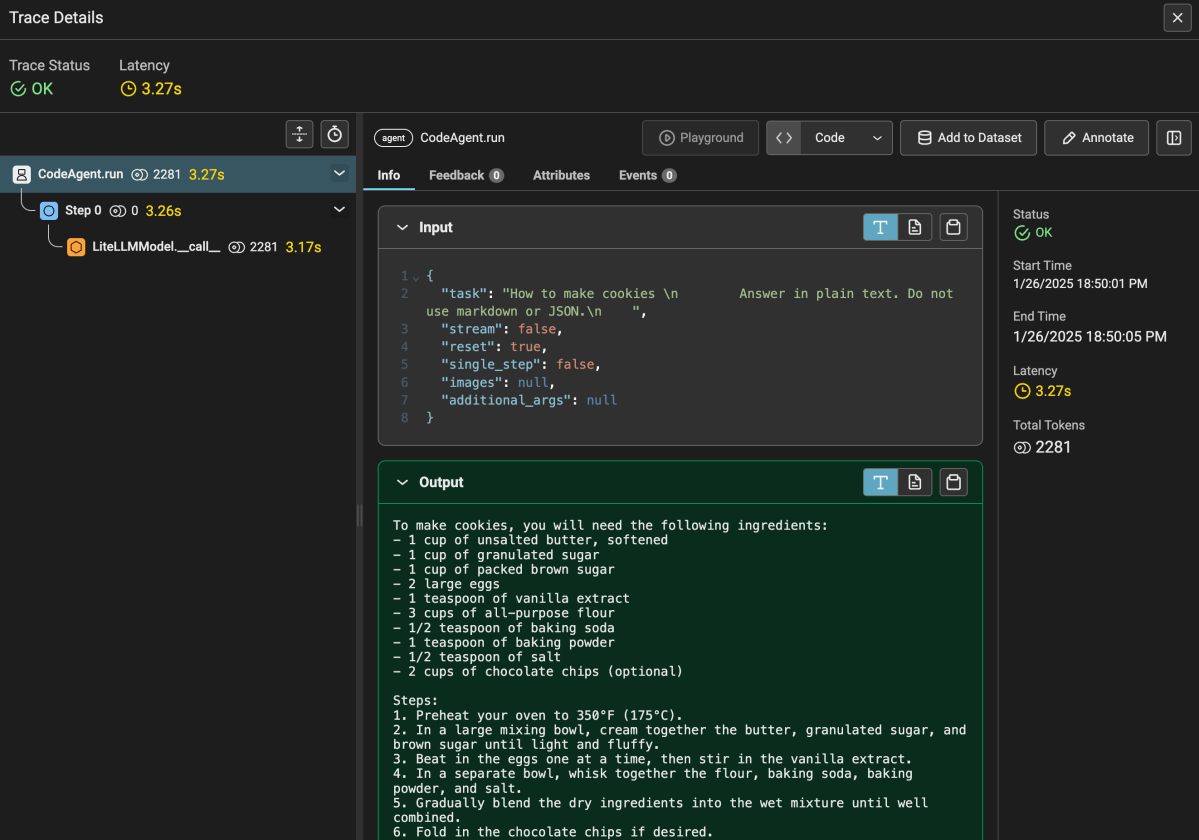
The result is not too exciting. But it does show that the agent works and is able to respond with the help of the Azure OpenAI model that you used. You should find a trace in Phoenix Arize as well:

How to make cookies trace

Above, the agent needed only one step. It’s important to know that we use a CodeAgent here. Such an agent writes code to provide you with an answer. The code it wrote was as follows:

Thought: I will write the answer in plain text detailing the steps to make cookies.

Code:
```py
cookie_recipe = """\
To make cookies, you will need the following ingredients:
- 1 cup of unsalted butter, softened
- 1 cup of granulated sugar
- 1 cup of packed brown sugar
- 2 large eggs
- 1 teaspoon of vanilla extract
- 3 cups of all-purpose flour
- 1/2 teaspoon of baking soda
- 1 teaspoon of baking powder
- 1/2 teaspoon of salt
- 2 cups of chocolate chips (optional)

Steps:
1. Preheat your oven to 350°F (175°C).
2. In a large mixing bowl, cream together the butter, granulated sugar, and brown sugar until light and fluffy.
3. Beat in the eggs one at a time, then stir in the vanilla extract.
4. In a separate bowl, whisk together the flour, baking soda, baking powder, and salt.
5. Gradually blend the dry ingredients into the wet mixture until well combined.
6. Fold in the chocolate chips if desired.
7. Drop spoonfuls of dough onto ungreased baking sheets, spacing them about 2 inches apart.
8. Bake in the preheated oven for about 10-12 minutes, or until the edges are golden brown.
9. Let the cookies cool on the baking sheets for a few minutes before transferring to wire racks to cool completely.

Enjoy your homemade cookies!
"""

final_answer(cookie_recipe)
```

Of course, smolagents uses a prompt to tell the model and specifically the Code Agent how to behave. The code generates a final answer which will be the answer the user sees.

Let’s take a look at get_started.py:

from smolagents import CodeAgent, LiteLLMModel
import os
import sys
from dotenv import load_dotenv

# instrumentation
from opentelemetry import trace
from opentelemetry.sdk.trace import TracerProvider
from opentelemetry.sdk.trace.export import BatchSpanProcessor

from openinference.instrumentation.smolagents import SmolagentsInstrumentor
from opentelemetry.exporter.otlp.proto.http.trace_exporter import OTLPSpanExporter
from opentelemetry.sdk.trace.export import ConsoleSpanExporter, SimpleSpanProcessor

endpoint = "http://0.0.0.0:6006/v1/traces"
trace_provider = TracerProvider()
trace_provider.add_span_processor(SimpleSpanProcessor(OTLPSpanExporter(endpoint)))

SmolagentsInstrumentor().instrument(tracer_provider=trace_provider)


def print_usage():
    print("\nUsage: python app.py \"your question in quotes\"")
    print("\nExample:")
    print("  python app.py \"Find the cheapest laptop\"")
    print("  python app.py \"Find a Python tutorial to write a FastAPI API\"")
    sys.exit(1)

def main():
    # Check if a question was provided
    if len(sys.argv) != 2:
        print("\nError: Please provide a question as a command-line argument.")
        print_usage()

    # Get the question from command line
    question = sys.argv[1]

    # Load environment variables from .env file
    load_dotenv()

    # Check for required environment variables
    if not os.getenv("AZURE_OPENAI_API_KEY"):
        print("\nError: OPENAI_API_KEY not found in .env file")
        sys.exit(1)
    if not os.getenv("BING_SUBSCRIPTION_KEY"):
        print("\nError: BING_SUBSCRIPTION_KEY not found in .env file")
        sys.exit(1)
    if not os.getenv("AZURE_API_BASE"):
        print("\nError: AZURE_API_BASE not found in .env file")
        sys.exit(1)
    if not os.getenv("AZURE_MODEL"):
        print("\nError: AZURE_MODEL not found in .env file")
        sys.exit(1)

    # get keys from .env
    azure_openai_api_key = os.getenv("AZURE_OPENAI_API_KEY")
    azure_api_base = os.getenv("AZURE_API_BASE")
    azure_model = os.getenv("AZURE_MODEL")
    # refer to Azure model as azure/NAME_OF_YOUR_DEPLOYED_MODEL
    model = LiteLLMModel(model_id=f"azure/{azure_model}", api_key=azure_openai_api_key, api_base=azure_api_base, max_tokens=4096)
    
    agent = CodeAgent(
        model=model,
        max_steps=10,
        verbosity_level=2,
        tools=[],
        # additional_authorized_imports=["requests", "bs4"]
    )

    extra_instructions="""
        Answer in plain text. Do not use markdown or JSON.
    """

    result = agent.run(question + " " + extra_instructions)

if __name__ == "__main__":
    main()
    

Most of the code is imports, getting environment variables etc… Let’s focus on the core:

  • Specifying the model the agent should use: smolagents relies on LiteLLM to give you access to many models. One of those is Azure OpenAI. To tell LiteLLM what model we use, we prefix the model name with azure/. You can also use models directly from Hugging Face or local models.
  • Creating the agent: in this case we use a CodeAgent instead of a ToolCallingAgent; as you have seen above, a CodeAgent writes Python code to provide answers and executes that Python code; you will see later how it handles tools
  • Doing an agent run: simply call the run method with your question; append extra instructions to your question as needed

The verbosity level ensures we can see what happens in the console:

Console logging by the agent

In just a few lines of code, you have an agent that can use code to answer your questions. There is no predefined path it takes.

Try asking “What is the last post on https://atomic-temporary-16150886.wpcomstaging.com“. It will try to write code that uses Python libraries that are not allowed by default. By uncommenting the additional_authorized_imports line, the agent will probably be able to answer the question anyway:

Answering “What is the last post on https://atomic-temporary-16150886.wpcomstaging.com?”

The agent decides to use the requests and BeatifulSoup libraries to scrape this blog and retrieve the latest post. How cool is that? 😉

Adding tools

Although you can let the agent run arbitrary code, you will probably want to give the agent extra tools. Those tools might require API keys and other parameters that the Code Agent will not know how to use. They might query internal knowledge bases or databases and much, much more.

As an example, we will give the agent a Bing Search tool. It can use the tool to search for information on the web. If you enable the additional imports, it can also scrape those URLs for extra content.

Note: smolagents has a default Google Search tool that uses the Serper API.

Note: scraping will not work for dynamically loaded content; use tools such as https://firecrawl.dev or https://jina.ai with those websites; alternatively, write a tool that uses a headless browser

If you cloned the repository, you have the following:

  • search.py: the same code as get_started.py but with the Bing tool included
  • a tools folder: contains bing_search.py that implements the tool

In search.py, you will find the following extra lines throughout the code:

from tools import bing_search  # import the tool

# add the tool to a list of tools
tools = [
  bing_search.BingSearchTool(api_key=bing_subscription_key)
]

# agent with tools
agent = CodeAgent(
     model=model,
     max_steps=10,
     verbosity_level=2,
     tools=tools,
     additional_authorized_imports=["requests", "bs4"]
)

A tool is either a Python class based on the smolagents Tool class, or a function decorated with the @tool decorator. Here, we are using a class:

  • The description field in the class is used by the agent to know what the tool can do
  • The inputs field describes the parameter the tool can accept
  • The output fields sets the type of the output, e.g., string

The most important method of the class is the forward method. When the agent uses the tool, it executes that method. Implement the tool’s behavior in that method. The code below is the Bing tool:

from smolagents import Tool
import requests
from typing import Dict, List

class BingSearchTool(Tool):
    name = "bing_search"
    description = """
    This tool performs a Bing web and image search and returns the top search results for a given query.
    It returns a string containing formatted search results including web pages and images.
    It is best for overview information or to find a url to scrape."""
    
    inputs = {
        "query": {
            "type": "string",
            "description": "The search query to look up on Bing",
        },
        "num_results": {
            "type": "integer",
            "description": "Number of search results to return (default: 5)",
            "default": 5,
            "nullable": True
        },
        "include_images": {
            "type": "boolean",
            "description": "Whether to include image results (default: False)",
            "default": False,
            "nullable": True
        }
    }
    output_type = "string"

    def __init__(self, api_key: str):
        super().__init__()
        self.api_key = api_key
        self.web_endpoint = "https://api.bing.microsoft.com/v7.0/search"
        self.image_endpoint = "https://api.bing.microsoft.com/v7.0/images/search"
        
    def _get_web_results(self, query: str, num_results: int) -> List[str]:
        headers = {"Ocp-Apim-Subscription-Key": self.api_key}
        params = {
            "q": query,
            "count": num_results,
            "textDecorations": False,
            "textFormat": "Raw"
        }
        
        response = requests.get(self.web_endpoint, headers=headers, params=params)
        response.raise_for_status()
        search_results = response.json()
        
        formatted_results = []
        for item in search_results.get("webPages", {}).get("value", []):
            result = f"Title: {item['name']}\nSnippet: {item['snippet']}\nURL: {item['url']}\n"
            formatted_results.append(result)
            
        return formatted_results

    def _get_image_results(self, query: str, num_results: int) -> List[str]:
        headers = {"Ocp-Apim-Subscription-Key": self.api_key}
        params = {
            "q": query,
            "count": num_results,
            "textDecorations": False,
            "textFormat": "Raw"
        }
        
        response = requests.get(self.image_endpoint, headers=headers, params=params)
        response.raise_for_status()
        image_results = response.json()
        
        formatted_results = []
        for item in image_results.get("value", []):
            result = f"Image Title: {item['name']}\nImage URL: {item['contentUrl']}\nThumbnail URL: {item['thumbnailUrl']}\nSource: {item['hostPageDisplayUrl']}\n"
            formatted_results.append(result)
            
        return formatted_results
        
    def forward(self, query: str, num_results: int = 5, include_images: bool = True) -> str:
        try:
            results = []
            
            # Get web results
            web_results = self._get_web_results(query, num_results)
            if web_results:
                results.append("=== Web Results ===")
                results.extend(web_results)
            
            # Get image results if requested
            if include_images:
                image_results = self._get_image_results(query, num_results)
                if image_results:
                    results.append("\n=== Image Results ===")
                    results.extend(image_results)
            
            return "\n".join(results) if results else "No results found."
            
        except requests.exceptions.RequestException as e:
            raise Exception(f"Bing search failed: {str(e)}") 

To try the tool, make sure you create a Bing Search resource in Azure and grab its key. Note that we are using Bing Search and not Bing Custom Search here. When you have the key, add it to the .env file:

BING_SUBSCRIPTION_KEY=your_bing_search_api_key

Now run the following command (or similar):

python search.py "Search the web for information about DeepSeek R1. Summarize and provide links"

The agent should use multiple steps before reaching the final answer:

Trace of the search

In step 0, the agent decides to use the BingSearchTool. It writes the following code and executes it (remember it is a CodeAgent):

results = bing_search(query="DeepSeek R1", num_results=5)
print(results)

The response is a list of web and images results.

Sometimes, there are steps that do not have code to execute. Step 1 and 2 provide LLM output which the CodeAgent cannot execute. In your case, it might not happen or it might be a different number of steps. In Step 3, that is solved as the assistant output is code that uses the final_answer call to provide the final answer and stop. It basically self corrects at the expense of some extra tokens:

Thought: I will correctly format the plain text summary in the code block to ensure it handles the string properly, and then provide the final answer.

Code:

summary = """
DeepSeek R1 is an advanced AI model developed by DeepSeek-AI. It uses large-scale reinforcement learning (RL) directly on the base model without relying on supervised fine-tuning (SFT) as a preliminary step. The model has been designed to perform a variety of reasoning tasks with high accuracy and speed. DeepSeek R1 and its variants, such as DeepSeek R1-Zero and DeepSeek R1-Lite-Preview, have been launched for web, app, and API usage, competing with other leading AI models like OpenAI's Model o1.

Key Highlights:
1. DeepSeek R1 GitHub Repository: https://github.com/deepseek-ai/DeepSeek-R1
2. DeepSeek Official Website: https://www.deepseek.com/
3. DeepSeek R1 Research Paper on arXiv: https://arxiv.org/abs/2501.12948
4. DeepSeek R1 API Documentation: https://api-docs.deepseek.com/news/news1120
5. Article on Nature about DeepSeek R1: https://www.nature.com/articles/d41586-025-00229-6

DeepSeek R1 is positioned as a powerful AI model with significant advancements in reasoning and inference capabilities, making it a competitive alternative to other leading models in the AI community.
"""
final_answer(summary)

Note: I feel those errors are a bug that might be related to the system prompt of the Code Agent.

Running code securely

Our Code Agent runs the code on the same system as the agent. For extra security, it is recommended to use secure code execution in a remote sandbox environment. To that end, smolagents supports E2B. Check the smolagents docs for more information.

E2B is similar to Azure Container Apps Dynamic Sessions. Sadly, smolagents does not support that yet.

Conclusion

We have barely scratched the surface of what is possible with smolagents. It is a small and simple library with which you can quickly build an agent that reasons, acts and observes in multiple steps until it reaches an answer. It supports a wide range of LLMs and has first-class support for Code Agents. We used the Code Agent in this post. There is another agent, the ToolCallingAgent, which uses the LLM to generate the tool calls using JSON. However, using the Code Agent is the recommended approach and is more flexible.

If you need to build applications where you want the LLM to decide on the course of actions, smolagents is an easy to use library to get started. Give it a go and try it out!

Creating an agent with the Azure AI Agent SDK

Source: Microsoft

Azure AI Agents Service simplifies building intelligent agents by combining advanced AI models, tools, and technology from Microsoft, OpenAI, and partners like Meta and Cohere. It enables integration with knowledge sources such as Bing, SharePoint, and Azure AI Search, and lets agents perform actions across Microsoft and third-party applications using Logic Apps, Azure Functions, and Code Interpreter. With Azure AI Foundry, you get an intuitive agent-building experience, backed by enterprise-grade features like customizable storage, private networking, secure authentication, and detailed observability through OpenTelemetry.

At the time of this writing (December 2024), Azure AI Foundry did not provide a user interface yet to create these agents in the portal. In this post, we will use the Azure AI Foundry SDK to create the agent from code.

You can find the code in this repository: https://github.com/gbaeke/agent_service/tree/main/agentui

How does it work?

The agent service uses the same wire protocol as the Azure OpenAI Assistants API. The Assistants API was developed as an alternative to the chat completions API. The big difference is that the Assistants API is stateful: your interactions with the AI model are saved as messages on a thread. You simply add messages to the thread for the model to respond.

For more information, check this video:

To get started, you need three things:

  • An agent: the agent uses a model and instructions about how it should behave. In addition, you add knowledge sources and tools. Knowledge sources can be files you upload to the agent or existing sources such as files on SharePoint. Tools can be built-in tools like code interpreter or custom tools like any API or custom functions that you write.
  • A thread: threads receive messages from users and the assistant (the model) responds with assistant messages. In a chat application, each of the user’s conversations can be a thread. Note that threads are created, independent of an agent. The thread is associated with the agent when you add a message.
  • Messages: you add messages to a thread and check the thread for new messages. Messages can contain both text and images. For example, if you use the code interpreter tool and you asked for a chart, the chart will be created and handed to you as a file id. To render the chart, you would need to download it first based on its id.

Creating the agent

Before we create the agent, we need to connect to our Azure AI Foundry project. To do that (and more), we need the following imports:

import os
from azure.ai.projects import AIProjectClient
from azure.ai.projects.models import CodeInterpreterTool
from azure.identity import DefaultAzureCredential
from fastapi import FastAPI
from typing import Dict
from azure.ai.projects.models import FunctionTool, ToolSet
from typing import Any, Callable, Set, Dict
from fastapi.middleware.cors import CORSMiddleware
from pydantic import BaseModel
import requests
import base64

We will use the AIProjectClient to get a reference to an Azure AI Foundry project. We do that with the following code:

# Set up credentials and project client
credential = DefaultAzureCredential()
conn_str = os.environ["PROJECT_CONNECTION_STRING"]
project_client = AIProjectClient.from_connection_string(
    credential=credential, conn_str=conn_str
)

Note that we authenticate with Entra ID. On your local machine, ensure you are logged on via the Azure CLI with az login. Your account needs at least AI Developer access to the Foundry project.

You also need the connection string to your project. The code requires it in the PROJECT_CONNECTION_STRING environment variable. You can find the connection string in Azure AI Foundry:

AI Foundry project connection string

We can now create the agent with the following code:

agent = project_client.agents.create_agent(
    model="gpt-4o-mini",
    name="my-agent",
    instructions="You are helpful agent with functions to turn on/off light and get temperature in a location. If location is not specified, ask the user.",
    toolset=toolset
)

Above, the agent uses gpt-4o-mini. You need to ensure that model is deployed in your Azure AI Foundry Hub. In our example, we also provide the assistant with tools. We will not provide it with knowledge.

What’s inside the toolset?

  • built-in code interpreter tool: provides a way for the model to write Python code, execute it and provide the result back to the model; the result can be text and/or images.
  • custom tools: in our case, custom Python functions to turn on/off lights and look up weather information in a location.

There are other tool types that we will not discuss in this post.

Adding tools

Let’s look at adding our own custom functions first. In the code, three functions are used as tools:

def turn_on_light(room: str) -> str:
    return f"Light in room {room} turned on"

def turn_off_light(room: str) -> str:
    return f"Light in room {room} turned off"

def get_temperature(location: str) -> str:
    # check the github repo for the code

The SDK provides helpers to turn these functions into tools the assistant understands:

user_functions: Set[Callable[..., Any]] = {
    turn_on_light,
    turn_off_light,
    get_temperature
}
functions = FunctionTool(user_functions)
toolset = ToolSet()
toolset.add(functions)

Now we need to add the built-in code interpreter:

code_interpreter = CodeInterpreterTool()
toolset.add(code_interpreter)

Now we have a toolset with three custom functions and the code interpreter. This toolset is given to the agent via the toolset parameter.

Now that we have an agent, we need to provide a way to create a thread and add messages to the thread.

Creating a thread

We are creating an API so we will create and endpoint to create a thread:

@app.post("/threads")
def create_thread() -> Dict[str, str]:
    thread = project_client.agents.create_thread()
    return {"thread_id": thread.id}

As discussed earlier, a thread is created as a separate entity. It is not associated with the agent when you create it. When we later add a message, the thread will be associated with the agent that should process the message.

Working with messages

Next, we will provide an endpoint that accepts a thread id and a message you want to add to it:

@app.post("/threads/{thread_id}/messages")
def send_message(thread_id: str, request: MessageRequest):
    created_msg = project_client.agents.create_message(
        thread_id=thread_id,
        role="user",
        content=request.message  # Now accessing message from the request model
    )
    run = project_client.agents.create_and_process_run(
        thread_id=thread_id,
        assistant_id=agent.id
    )
    if run.status == "failed":
        return {"error": run.last_error or "Unknown error"}

    messages = project_client.agents.list_messages(thread_id=thread_id)
    last_msg = messages.get_last_message_by_sender("assistant")
    
    last_msg_text = last_msg.text_messages[0].text.value if last_msg.text_messages else None
    last_msg_image = last_msg.image_contents[0].image_file if last_msg.image_contents else None
    
    last_msg_image_b64 = None
    if last_msg_image:
        file_stream = project_client.agents.get_file_content(file_id=last_msg_image.file_id)
        base64_encoder = base64.b64encode
        byte_chunks = b"".join(file_stream)  # Concatenate all bytes from the iterator.
        last_msg_image_b64 = base64_encoder(byte_chunks).decode("utf-8")
        
    return {"assistant_text": last_msg_text, 
            "assistant_image": last_msg_image_b64}

The code is pretty self-explanatory. In summary, here is what happens:

  • a message is created with the create_message method; the message is added to the specified thread_id as a user message
  • the thread is run on the agent specified by the agent.id
  • to know if the run is finished, polling is used; the create_and_process_run hides that complexity for you
  • messages are retrieved from the thread but only the last assistant message is used
  • we extract the text and image from the message if it is present
  • when there is an image, we use get_file_content to retrieve the file content from the API; that functions returns an Iterator of bytes that are joined together and base64 encoded
  • the message and image are returned

Testing the API

When we POST to the threads enpoint, this is the response:

{
  "thread_id": "thread_meYRMrkRtUiI1u0ZGH0z7PEN"
}

We can use that id to post to the messages endpoint. For example in a .http file:

POST http://localhost:8000/threads/thread_meYRMrkRtUiI1u0ZGH0z7PEN/messages
Content-Type: application/json

{
    "message": "Create a sample bar chart"
}

The response to the above request should be something like below:

{
  "assistant_text": "Here is a sample bar chart displaying four categories (A to D) with their corresponding values. If you need any modifications or another type of chart, just let me know!",
  "assistant_image": "iVBORw0KGgoAAAANSUhEUgAABpYAAARNCAYAAABYAnNeAAAAOXRFWHRTb2Z0d2FyZQBNYXRwbG90bGliIHZlcnNpb24zLjQuMywgaHR0cHM6Ly9tYXRwbG90bGliLm9yZy/MnkTPAAAACXBIWXMAAB7CAAAewgFu0HU+AADWf0lEQ..."
}

In this case, the model determined that the code interpreter should be used to create the sample bar chart. When you ask for something simpler, like the weather, you get the following response:

{
  "assistant_text": "The current temperature in London is 11.4°C. If you need more information or updates, feel free to ask!",
  "assistant_image": null
}

In this case, our custom weather function was used to answer. The assistant determines what tools should be used to provide an answer.

Integration in a web app

The GitHub repository contains a sample UI to try the API:

Sample UI and a chat combining weather and plotting

Beautiful, is it not? 😂

Conclusion

The Azure AI Agent service makes it relatively easy to create an agent that has access to knowledge and tools. The assistant decides on its own how to use the knowledge and tools. However, you can steer the assistant via its instructions and influence how the assistant behaves.

The SDK makes it easy to add your own custom functions as tools, next to the built-in tools that it supports. Soon, there will be an Agent Service user interface in Azure AI Foundry. You will be able to create agents in code that reference the agents you have built in Foundry.

To try it for yourself, use the code in the GitHub repo. Note that the code is demo code with limited error handling. It’s merely meant to demonstrate first steps.

Enjoy and let me know what you build with it! 😉