Finding images with text and image queries with the help of GPT-4 Vision

With the gpt-4-vision-preview model available at OpenAI, it was time to build something with it. I decided to use it as part of a quick solution that can search for images with text, or by providing a similar image.

We will do the following:

  • Describe a collection of images. To generate the description, GPT-4 Vision is used
  • Create a text embedding of the description with the text-embedding-ada-002 model
  • Create an image embedding using the vectorizeImage API, part of Azure AI Computer Vision
  • Save the description and both embeddings to an Azure AI Search index
  • Search for images with either text or a similar image

The end result should be that when I search for desert plant, I get an image of a cactus or similar plant. When I provide a picture of an apple, I should get an apple or other fruit as a result. It’s basically Google image and reverse image search.

Let’s see how it works and if it is easy to do. The code is here: https://github.com/gbaeke/vision. The main code is in a Jupyter notebook in the image_index folder.

A word on vectors and vectorization

When we want to search for images using text or find similar images, we use a technique that involves turning both text and images into a form that a computer can understand easily. This is done by creating vectors. Think of vectors as a list of numbers that describe the important parts of a text or an image.

For text, we use a tool called ‘text-embedding-ada-002’ which changes the words and sentences into a vector. This vector is like a unique fingerprint of the text. For images, we use something like Azure’s multi-modal embedding API, which does the same thing but for pictures. It turns the image into a vector that represents what’s in the picture.

After we have these vectors, we store them in a place where they can be searched. We will use Azure AI Search. When you search, the system looks for the closest matching vectors – it’s like finding the most similar fingerprint, whether it’s from text or an image. This helps the computer to give you the right image when you search with words or find images that are similar to the one you have.

Getting a description from an image

Although Azure has Computer Vision APIs to describe images, GPT-4 with vision can do the same thing. It is more flexible and easier to use because you have the ability to ask for what you want with a prompt.

To provide an image to the model, you can provide a URL or the base64 encoding of an image file. The code below uses the latter approach:

def describe_image(image_file: str) -> str:
    with open(f'{image_file}', 'rb') as f:
        image_base64 = base64.b64encode(f.read()).decode('utf-8')
        print(image_base64[:100] + '...')

    print(f"Describing {image_file}...")

    response = client.chat.completions.create(
        model="gpt-4-vision-preview",
        messages=[
            {
            "role": "user",
            "content": [
                {"type": "text", "text": "Describe the image in detail"},
                {
                "type": "image_url",
                "image_url": {
                    "url": f"data:image/jpeg;base64,{image_base64}",
                },
                },
            ],
            }
        ],
        max_tokens=500,  # default max tokens is low so set higher
    )

    return response.choices[0].message.content

As usual, the OpenAI API is very easy to use. Above, we open and read the image and base64-encode it. The base64 encoded file is provided in the url field. A simple prompt is all you need to get the description. Let’s look at the result for the picture below:

The generated description is below:

The image displays a single, healthy-looking cactus planted in a terracotta-colored pot against a pale pink background. The cactus is elongated, predominantly green with some modest blue hues, and has evenly spaced spines covering its surface. The spines are white or light yellow, quite long, and arranged in rows along the cactus’s ridges. The pot has a classic, cylindrical shape with a slight lip at the top and appears to be a typical pot for houseplants. The overall scene is minimalistic, with a focus on the cactus and the pot due to the plain background, which provides a soft contrast to the vibrant colors of the plant and its container.

Description generated by GPT-4 Vision

Embedding of the image

To create an embedding for the image, I decided to use Azure’s multi-modal embedding API. Take a look at the code below:

def get_image_vector(image_path: str) -> list:
    # Define the URL, headers, and data
    url = "https://AI_ACCOUNT.cognitiveservices.azure.com//computervision/retrieval:vectorizeImage?api-version=2023-02-01-preview&modelVersion=latest"
    headers = {
        "Content-Type": "application/octet-stream",
        "Ocp-Apim-Subscription-Key": os.getenv("AZURE_AI_KEY")
    }

    with open(image_path, 'rb') as image_file:
        # Read the contents of the image file
        image_data = image_file.read()

    print(f"Getting vector for {image_path}...")

    # Send a POST request
    response = requests.post(url, headers=headers, data=image_data)

    # return the vector
    return response.json().get('vector')

The code uses an environment variable to get the key to an Azure AI Services multi-service endpoint. Check the README.md in the repository for a sample .env file.

The API generates a vector with 1024 dimensions. We will need that number when we create the Azure AI Search index.

Note that this API can accept a url or the raw image data (not base64-encoded). Above, we provide the raw image data and set the Content-Type properly.

Generating the data to index

In the next step, we will get all .jpg files from a folder and do the following:

  • create the description
  • create the image vector
  • create the text vector of the description

Check the code below for the details:

# get all *.jpg files in the images folder
image_files = [file for file in os.listdir('./images') if file.endswith('.jpg')]

# describe each image and store filename and description in a list of dicts
descriptions = []
for image_file in image_files:
    try:
        description = describe_image(f"./images/{image_file}")
        image_vector = get_image_vector(f"./images/{image_file}")
        text_vector = get_text_vector(description)
        
        descriptions.append({
            'id': image_file.split('.')[0], # remove file extension
            'fileName': image_file,
            'imageDescription': description,
            'imageVector': image_vector,
            'textVector': text_vector
        })
    except Exception as e:
        print(f"Error describing {image_file}: {e}")

# print the descriptions but only show first 5 numbers in vector
for description in descriptions:
    print(f"{description['fileName']}: {description['imageDescription'][:50]}... {description['imageVector'][:5]}... {description['textVector'][:5]}...")

The important part is the descriptions list, which is a list of JSON objects with fields that match the fields in the Azure AI Search index we will build in the next step.

The text vector is calculated with the get_text_vector function. It uses OpenAI’s text-embedding-ada-002 model.

Building the index

The code below uses the Azure AI Search Python SDK to build and populate the index in code. You.will need an AZURE_AI_SEARCH_KEY environment variable to authenticate to your Azure AI Search instance.

def blog_index(name: str):
    from azure.search.documents.indexes.models import (
        SearchIndex,
        SearchField,
        SearchFieldDataType,
        SimpleField,
        SearchableField,
        VectorSearch,
        VectorSearchProfile,
        HnswAlgorithmConfiguration,
    )

    fields = [
        SimpleField(name="Id", type=SearchFieldDataType.String, key=True), # key
        SearchableField(name="fileName", type=SearchFieldDataType.String),
        SearchableField(name="imageDescription", type=SearchFieldDataType.String),
        SearchField(
            name="imageVector",
            type=SearchFieldDataType.Collection(SearchFieldDataType.Single),
            searchable=True,
            vector_search_dimensions=1024,
            vector_search_profile_name="vector_config"
        ),
        SearchField(
            name="textVector",
            type=SearchFieldDataType.Collection(SearchFieldDataType.Single),
            searchable=True,
            vector_search_dimensions=1536,
            vector_search_profile_name="vector_config"
        ),

    ]

    vector_search = VectorSearch(
        profiles=[VectorSearchProfile(name="vector_config", algorithm_configuration_name="algo_config")],
        algorithms=[HnswAlgorithmConfiguration(name="algo_config")],
    )
    return SearchIndex(name=name, fields=fields, vector_search=vector_search)

#  create the index
from azure.core.credentials import AzureKeyCredential
from azure.search.documents import SearchClient
from azure.search.documents.indexes import SearchIndexClient
from azure.search.documents.models import VectorizedQuery

service_endpoint = "https://YOUR_SEARCH_INSTANCE.search.windows.net"
index_name = "image-index"
key = os.getenv("AZURE_AI_SEARCH_KEY")

index_client = SearchIndexClient(service_endpoint, AzureKeyCredential(key))
index = blog_index(index_name)

# create the index
try:
    index_client.create_index(index)
    print("Index created")
except Exception as e:
    print("Index probably already exists", e)

The code above creates an index with some string fields and two vector fields:

  • imageVector: 1024 dimensions (as defined by the Azure AI Computer Vision image embedder)
  • textVector: 1536 dimensions (as defined by the OpenAI embedding model)

Although not specified in the code, the index will use cosine similarity to perform similarity searches. It’s the default. It will return approximate nearest neighbour (ANN) results unless you create a search client that uses exhaustive search. An exhaustive search searches the entire vector space. The queries near the end of this post use the exhaustive setting.

When the index is created, we can upload documents:

# now upload the documents
try:
    search_client = SearchClient(service_endpoint, index_name, AzureKeyCredential(key))
    search_client.upload_documents(descriptions)
    print("Documents uploaded successfully")
except Exception as e:
    print("Error uploading documents", e)

The upload_documents method uploads the documents in the descriptions Python list to the search index. The upload is actually an upsert. You can run this code multiple times without creating duplicate documents in the index.

Search images with text

To search an image with a text description, a vector query on the textVector is used. The function below takes a text query string as input, vectorizes the query, and performs a similarity search returning the first nearest neighbour. The function displays the description and the image in the notebook:

# now search based on text
def single_vector_search(query: str):
    vector_query = VectorizedQuery(vector=get_text_vector(query), k_nearest_neighbors=1, fields="textVector", exhaustive=True)

    results = search_client.search(
        vector_queries=[vector_query],
        select=["fileName", "imageDescription"],
        
    )

    for result in results:
        print(result['fileName'], result["imageDescription"], sep=": ")

        # show the image
        from IPython.display import Image
        display(Image(f"./images/{result['fileName']}"))
    
single_vector_search("desert plant")

The code searches for an image based on the query desert plant. It returns the picture of the cactus shown earlier. Note that if you search for something there is no image for, like blue car, you will still get a result because we always return a nearest neighbor. Even if your nearest neighbor lives 100km away, it’s still your nearest neighbor. 😀

Return similar images

Since our index contains an image vector, we can search for images similar to a vector of a reference image. The function below takes an image file path as input, calculates the vector for that image, and performs a nearest neighbor search. The function displays the description and image of each document returned. In this case, the code returns two similar documents:

def image_search(image_file: str):

    vector_query = VectorizedQuery(vector=get_image_vector(image_file), k_nearest_neighbors=2, fields="imageVector", exhaustive=True)

    results = search_client.search(
        vector_queries=[vector_query],
        select=["fileName", "imageDescription"],
    )

    for result in results:
        print(result['fileName'], result["imageDescription"], sep=": ")

        # show the image
        from IPython.display import Image
        display(Image(f"./images/{result['fileName']}"))
 
# get vector of another image and find closest match
image_search('rotten-apple.jpg')
image_search('flower.jpeg')

At the bottom, the function is called with filenames of pictures that contain a rotten apple and a flower. The result of the first query is a picture of the apple and banana. The result of the second query is the cactus and the rose. You can debate whether the cactus should be in the results. Some cacti have flowers but some don’t. 😀

Conclusion

The GPT-4 Vision API, like most OpenAI APIs, is very easy to use. In this post, we used it to generate image descriptions to build a simple query engine that can search for images via text or a reference image. Together with their text embedding API and Microsoft’s multi-modal embedding API to create an image embedding, it is relatively straightforward to build these type of systems.

As usual, this is a tutorial with quick sample code to illustrate the basic principle. If you need help building these systems in production, simply reach out. Help is around the corner! 😉

Using Integrated Vectorization in Azure AI Search

The vector search capability of Azure AI Search became generally available mid November 2023. With that release, the developer is responsible for creating embeddings and storing them in a vector field in the index.

However, Microsoft also released integrated vectorization in preview. Integrated vectorization is useful in two ways:

  • You can define a vectorizer in the index schema. It can be used to automatically convert a query to a vector. This is useful in the Search Explorer in the portal but can also be used programmatically.
  • You can use an embedding skill for your indexer that automatically vectorizes index fields for you.

First, let’s look at defining a vectorizer in the index definition and using it in the portal for search.

Vector search in the portal

Below is a screenshot of an index with a title and a titleVector field. The index stores information about movies:

Index with a vector field

The integrated vectorizer is defined in the Vector profiles section:

Vector profile

When you add the profile, you configure the algorithm and vectorizer. The vectorizer simply points to an embedding model in Azure OpenAI. For example:

Vectorizer

Note: it’s recommended to use managed identity

Now, from JSON View in Search Explorer, you can perform a vector search. If you see a search field at the top, you can remove that. It’s for full-text search.

Vector search in the portal

Above, the query commencement is converted to a vector by the integrated vectorizer. The vector search comes up with Inception as the first match. I am not sure if you would want to search for movies this way but it proves the point. 😛

Using an embedding skill during indexing

Suppose you have several JSON documents about movies. Below is one example:

{
    "title": "Inception",
    "year": 2010,
    "director": "Christopher Nolan",
    "genre": ["Action", "Adventure", "Sci-Fi"],
    "starring": ["Leonardo DiCaprio", "Joseph Gordon-Levitt", "Ellen Page"],
    "imdb_rating": 8.8
  }

When you have a bunch of these files in Azure Blob Storage, you can use the Import Data wizard to construct an index from these files.

Import Data Wizard

This wizard, at the time of writing, does not create vectors for you. There is another wizard, Import and vectorize data, but it will treat the JSON as any document and store it in a content field. A vector is created from the content field.

We will stick to the first wizard. It will do several things:

  • create a data source to access the JSON documents in an Azure Storage Account container
  • infer the schema from the JSON files
  • propose an index definition that you can alter
  • create an indexer that indexes the documents on the schedule that you set
  • add skills like entity extraction; select a simple skill here like translation so you are sure there will be a skillset that the indexer will use

In the step to customize the index definition, ensure you make fields searchable and retrievable as needed. In addition, define a vector field. In my case, I created a titleVector field:

titleVector

When the wizard is finished, the indexer will run and populate the index. Of course, the titleVector field will be empty because there is no process in place that calculates the vectors during indexing.

Let’s fix that. In Skillsets, go the the skillset created by the wizard and click it.

Skillset created by the wizard

Replace the Skillset JSON definition with the content below and change resourceUri, apiKey and deploymentId as needed. You can also add the embedding skill to the existing array of skills if you want to keep them.

{
  "@odata.context": "https://acs-geba.search.windows.net/$metadata#skillsets/$entity",
  "@odata.etag": "\"0x8DBF01523E9A94D\"",
  "name": "azureblob-skillset",
  "description": "Skillset created from the portal. skillsetName: azureblob-skillset; contentField: title; enrichmentGranularity: document; knowledgeStoreStorageAccount: ;",
  "skills": [
    {
      "@odata.type": "#Microsoft.Skills.Text.AzureOpenAIEmbeddingSkill",
      "name": "embed",
      "description": null,
      "context": "/document",
      "resourceUri": "https://OPENAI_INSTANCE.openai.azure.com",
      "apiKey": "AZURE_OPENAI_KEY",
      "deploymentId": "EMBEDDING_MODEL",
      "inputs": [
        {
          "name": "text",
          "source": "/document/title"
        }
      ],
      "outputs": [
        {
          "name": "embedding",
          "targetName": "titleVector"
        }
      ],
      "authIdentity": null
    }
  ],
  "cognitiveServices": null,
  "knowledgeStore": null,
  "indexProjections": null,
  "encryptionKey": null
}

Above, we want to embed the title field in our document and create a vector for it. The context is set to /document which means that this skill is executed for each document once.

Now save the skillset. This skill on its own will create the vectors but will not save them in the index. You need to update the indexer to write the vector to a field.

Let’s navigate to the indexer:

Indexer

Click the indexer and go to the Indexer Definition (JSON) tab. Ensure you have an outputFieldMappings section like below:

{
  "@odata.context": "https://acs-geba.search.windows.net/$metadata#indexers/$entity",
  "@odata.etag": "\"0x8DBF01561D9E97F\"",
  "name": "movies-indexer",
  "description": "",
  "dataSourceName": "movies",
  "skillsetName": "azureblob-skillset",
  "targetIndexName": "movies-index",
  "disabled": null,
  "schedule": null,
  "parameters": {
    "batchSize": null,
    "maxFailedItems": 0,
    "maxFailedItemsPerBatch": 0,
    "base64EncodeKeys": null,
    "configuration": {
      "dataToExtract": "contentAndMetadata",
      "parsingMode": "json"
    }
  },
  "fieldMappings": [
    {
      "sourceFieldName": "metadata_storage_path",
      "targetFieldName": "metadata_storage_path",
      "mappingFunction": {
        "name": "base64Encode",
        "parameters": null
      }
    }
  ],
  "outputFieldMappings": [
    {
      "sourceFieldName": "/document/titleVector",
      "targetFieldName": "titleVector"
    }
  ],
  "cache": null,
  "encryptionKey": null
}

Above, we map the titleVector enrichment (think of it as something temporary during indexing) to the real titleVector field in the index.

Reset and run the indexer

Reset the indexer so it will index all documents again:

Resetting the indexer

Next, click the Run button to start the indexing process. When it finishes, do a search with Search Explorer and check that there are vectors in the titleVector field. It’s an array of 1536 floating point numbers.

Conclusion

Integrated vectorization is a welcome extra feature in Azure AI Search. Using it in searches is very easy, especially in the portal.

Using the embedding skill is a bit harder, because you need to work with skillset and indexer definitions in JSON and you have to know exactly what you have to add. But once you get it right, the indexer does all the vectorization work for you.

Creating a custom GPT to query any knowledge base with actions

A while ago, OpenAI introduced GPTs. A GPT is a custom version of ChatGPT that combine instructions, extra knowledge, and any combination of skills.

In this tutorial, we are going to create a custom GPT that can answer questions about articles on this blog. In order to achieve that, we will do the following:

  • create an Azure AI Search index
  • populate the index with content of the last 50 blog posts (via its RSS feed)
  • create a custom API with FastAPI (Python) that uses the Azure OpenAI “add your data” APIs to provide relevant content to the user’s query
  • add the custom API as an action to the custom GPT

The image below shows the properties of the GPT. You need to be a ChatGPT Plus subscriber to create a GPT.

Part of the custom GPT definition

To implement a custom action for the GPT, you need an API with an OpenAPI spec. When you use FastAPI, an OpenAPI JSON document can easily be downloaded and provided to the GPT. You will need to modify the JSON document with a servers section to specify the URL the GPT has to use.

In what follows, we will look at all of the different pieces that make this work. Beware: long post! 😀

Azure AI Search Index

Azure AI Search is a search service you create in Azure. Although there is a free tier, I used the basic tier. The basic tiers allows you to use its semantic reranker to optimise search results.

To create the index and populate it with content, I used the following notebook: https://github.com/gbaeke/custom-gpt/blob/main/blog-index/website-index.ipynb.

The result is an index like below:

Index in Azure AI Search

The index contains 292 documents although I only retrieve the last 50 blog posts. This is the result of chunking each post into smaller pieces of about 500 tokens with 100 tokens of overlap for each chunk. We use smaller chunks because we do not want to send entire blog posts as content to the large language model (LLM).

Note that the index supports similarity searches using vectors. The contentVector field contains the OpenAI embedding of the text in the content field.

Although vectors are available, we do not have to use vector search. Azure AI search supports simple keyword search as well. Together with the semantic ranker, it can provide more relevant results than keyword search on its own.

Note: in general, vector search will provide better results, especially when combined with keyword search and the semantic ranker

Use the index with Azure OpenAI “add your data”

I have written about the Azure OpenAI “add your data” features before. It provides a wizard experience to add an Azure AI Search index to the Azure OpenAI playground and directly test your index with the model of your choice.

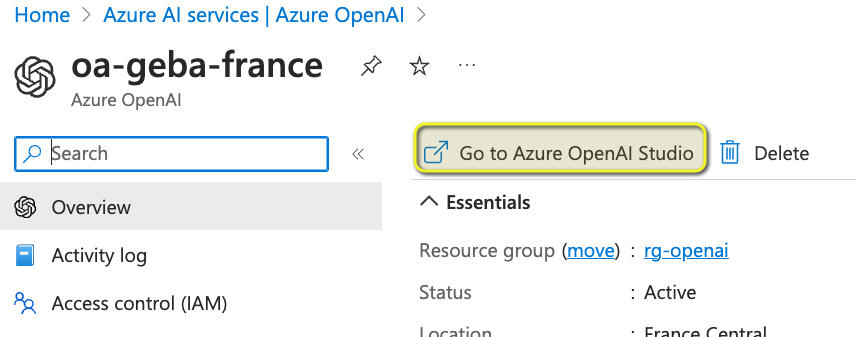
From you Azure OpenAI instance, first open Azure OpenAI Studio:

Go to OpenAI Studio from the Overview page of your Azure OpenAI instance

Note: you still need to complete a form to get access to Azure OpenAI. Currently, it can take around a day before you are allowed to create Azure OpenAI instances in your subscription.

In Azure OpenAI Studio, click Bring your own data from the Home screen:

Bring your own data

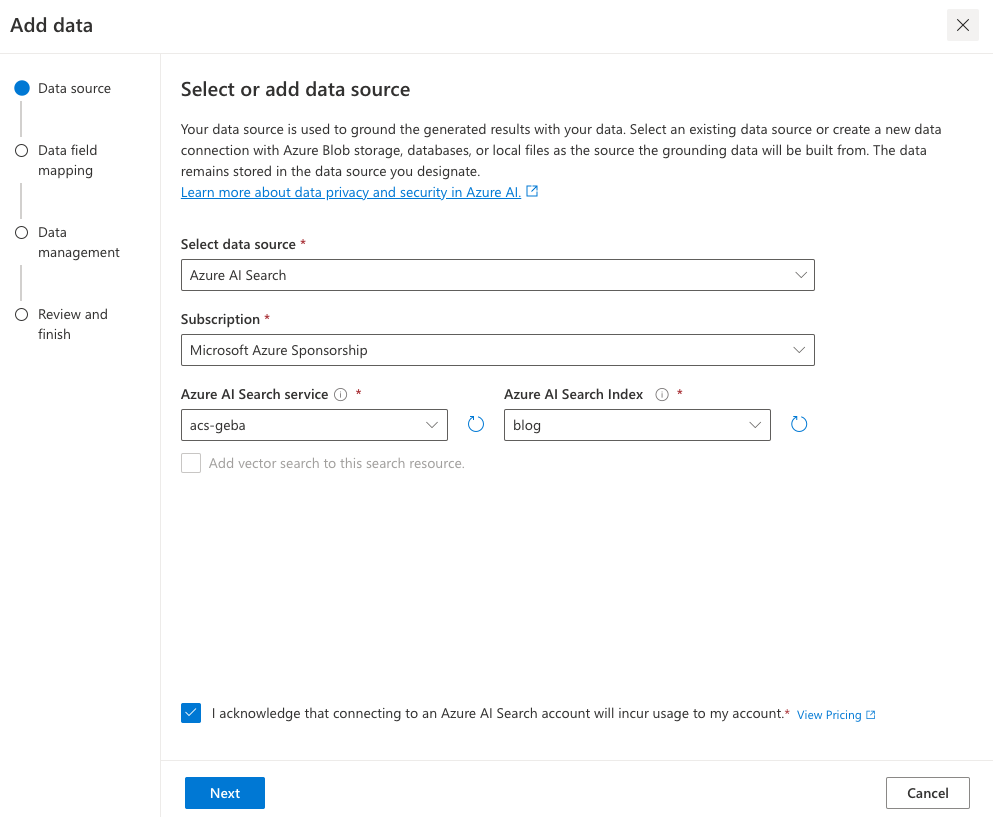
Select the Azure AI Search index and click Next.

Azure AI Search index selection

Note: I created the index using the generally available API that supports vector search. The Add your data wizard, at the time of writing, was not updated yet to support these new indexes. That is the reason why vector search cannot be enabled. We will use keyword + semantic search instead. I expect this functionality to be available soon (November/December 2023).

Next, provide field mappings:

Field Mappings

These mappings are required because the Add your data feature excepts these standard fields. You should have at least a content field to search. Above, I do not have a file name field because I have indexed blog posts. It’s ok to leave that field blank.

After clicking Next, we get to data management:

Data Management

Here, we specify the type of search. Semantic means keyword + semantic. In the dropdown list, you can also select keyword search on its own. However, that might give you less relevant results.

Note: for Semantic to work, you need to turn on the Semantic ranker on the Azure AI Search resource. Additionally, you need to create a semantic profile on the index.

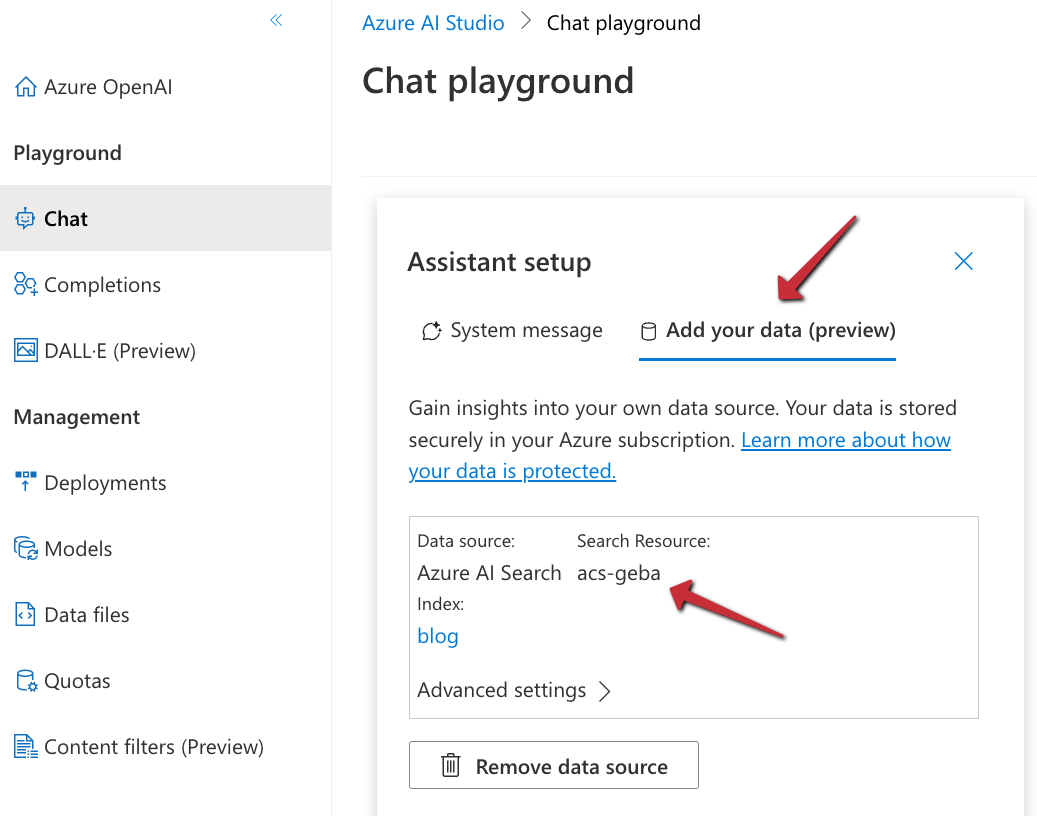
Now you can click Next, followed by Save and close. The Azure OpenAI Chat Playground appears with the index added:

Index added as a data source

You can now start chatting with your data. Select a chat model like gpt-4 or gpt-35-turbo. In Azure OpenAI, you have to deploy these models first and give the deployment a name.

Chat session with your data

Above, I asked about the OpenAI Assistants API, which is one of the posts on my blog. In the background, the playground performs a search on the Azure AI Search index and provides the results as context to the model. The gpt-35-turbo model answers the user’s question, based on the context coming from the index.

When you are happy with the result, you can export this experience to an Azure Web App of CoPilot Studio (Power Virtual Agents):

Export the “chat with data” experience

In our case, we want to use this configuration from code and provide an API we can add to the custom GPT.

⚠️ It’s import to realise that, with this approach, we will send the final answer, generated by an Azure OpenAI model, to the custom GPT. An alternate approach would be to hand the results of the Azure AI Search query to the custom GPT and let it formulate the answer on its own. That would be faster and less costly. If you also provide the blog post’s URL, ChatGPT can refer to it. However, the focus here is on using any API with a custom GPT so let’s continue with the API that uses the “add your data” APIs.

If you want to hand over Azure AI search results directly to ChatGPT, check out the code in the azure-ai-search folder in the Github repo.

Creating the API

To create an API that uses the index with the model, as configured in the playground, we can use some code. In fact, the playground provides sample code to work with:

Sample code from the playground

‼️ Sadly, this code will not work due to changes to the openai Python package. However, the principle is still the same:

  • call the chat completion extension API which is specific to Azure; in the code you will see this is as a Python f-string: f"{openai.api_base}/openai/deployments/{deployment_id}/extensions/chat/completions?api-version={openai.api_version}"
  • the JSON payload for this API needs to include the Azure AI Search configuration in a dataSources array.

The extension API will query Azure AI Search for you and create the prompt for the chat completion with context from the search result.

To create a FastAPI API that does this for the custom GPT, I decided to not use the openai package and simply use the REST API. Here is the code:

from fastapi import FastAPI, HTTPException, Depends, Header
from pydantic import BaseModel
import httpx, os
import dotenv
import re

# Load environment variables
dotenv.load_dotenv()

# Initialize FastAPI app
app = FastAPI()

# Constants (replace with your actual values)
api_base = "https://oa-geba-france.openai.azure.com/"
api_key = os.getenv("OPENAI_API_KEY")
deployment_id = "gpt-35-turbo"
search_endpoint = "https://acs-geba.search.windows.net"
search_key = os.getenv("SEARCH_KEY")
search_index = "blog"
api_version = "2023-08-01-preview"

# Pydantic model for request body
class RequestBody(BaseModel):
    query: str

# Define the API key dependency
def get_api_key(api_key: str = Header(None)):
    if api_key is None or api_key != os.getenv("API_KEY"):
        raise HTTPException(status_code=401, detail="Invalid API Key")
    return api_key

# Endpoint to generate response
@app.post("/generate_response", dependencies=[Depends(get_api_key)])
async def generate_response(request_body: RequestBody):
    url = f"{api_base}openai/deployments/{deployment_id}/extensions/chat/completions?api-version={api_version}"
    headers = {
        "Content-Type": "application/json",
        "api-key": api_key
    }
    data = {
        "dataSources": [
            {
                "type": "AzureCognitiveSearch",
                "parameters": {
                    "endpoint": search_endpoint,
                    "key": search_key,
                    "indexName": search_index
                }
            }
        ],
        "messages": [
            {
                "role": "system",
                "content": "You are a helpful assistant"
            },
            {
                "role": "user",
                "content": request_body.query
            }
        ]
    }

    async with httpx.AsyncClient() as client:
        response = await client.post(url, json=data, headers=headers, timeout=60)

    if response.status_code != 200:
        raise HTTPException(status_code=response.status_code, detail=response.text)

    response_json = response.json()

    # get the assistant response
    assistant_content = response_json['choices'][0]['message']['content']
    assistant_content = re.sub(r'\[doc.\]', '', assistant_content)
    
    # return assistant_content as json
    return {
        "response": assistant_content
    }

# Run the server
if __name__ == "__main__":
    import uvicorn
    uvicorn.run(app, host="0.0.0.0", port=8000, timeout_keep_alive=60)

This API has one endpoint: /generate_response that takes { "query": "your query" }as input and returns { "response": assistant_content }as output. Note that the original response from the model contains references like [doc1], [doc2], etc… The regex in the code removes those references. I don not particularly like how the references are handled by the API so I decided to not include them and simplify the response.

The endpoint expects an api-key header. It it is not present, it returns an error.

The endpoint does a call to the Azure OpenAI chat completion extension API which looks very similar to a regular OpenAI chat completion. The request does however, contain a dataSources field with the Azure AI Search information.

The environment variables like the OPENAI_API_KEY and the SEARCH_KEY are retrieved from a .env file.

Note: to stress this again, this API returns the answer to the query as generated by the chosen Azure OpenAI model. This allows it to be used in any application, not just a custom GPT. For a custom GPT in ChatGPT, an alternate approach would be to hand over the search results from Azure AI search directly, allowing the model in the custom GPT to generate the response. It would be faster and avoid Azure OpenAI costs. We are effectively using the custom GPT as a UI and as a way to maintain history between action calls. 😀

If you want to see the code in GitHub, check this URL: https://github.com/gbaeke/custom-gpt.

Running the API in Azure Container Apps

To run the API in the cloud, I decided to use Azure Container Apps. That means we need a Dockerfile to build the container image locally or in the cloud:

# Use an official Python runtime as a parent image
FROM python:3.9-slim-buster

# Set the working directory in the container to /app
WORKDIR /app

# Add the current directory contents into the container at /app
ADD . /app

# Install any needed packages specified in requirements.txt
RUN pip install --no-cache-dir -r requirements.txt

# Run app.py when the container launches
CMD ["python3", "app.py"]

We also need a requirements.txt file:

fastapi==0.104.1
pydantic==2.5.2
pydantic_core==2.14.5
httpx==0.25.2
python-dotenv==1.0.0
uvicorn==0.24.0.post1

I use the following shell script to build and run the container locally. The script can also push the container to Azure Container Apps.

#!/bin/bash

# Load environment variables from .env file
export $(grep -v '^#' .env | xargs)

# Check the command line argument
if [ "$1" == "build" ]; then
    # Build the Docker image
    docker build -t myblog .
elif [ "$1" == "run" ]; then
    # Run the Docker container, mapping port 8000 to 8000 and setting environment variables
    docker run -p 8000:8000 -e OPENAI_API_KEY=$OPENAI_API_KEY -e SEARCH_KEY=$SEARCH_KEY -e API_KEY=$API_KEY myblog
elif [ "$1" == "up" ]; then
    az containerapp up -n myblog --ingress external --target-port 8000 \
        --env-vars OPENAI_API_KEY=$OPENAI_API_KEY SEARCH_KEY=$SEARCH_KEY API_KEY=$API_KEY \
        --source .
else
    echo "Usage: $0 {build|run|up}"
fi

The shell script extracts the environment variables defined in .env and sets them in the session. Next, we check the first parameter given to the script (Docker is required on your machine for build and run):

  • build: build the Docker image
  • run: run the Docker image locally on port 8000 and specify the environment variables to authenticate to Azure OpenAI and Azure AI Search
  • up: build the Docker image in the cloud and run it in Container Apps; if you do not have a Container Apps Environment or Azure Container Registry, they will be created for you. In the end, you will get an https endpoint to your API in the cloud.

Note: you should not put secrets in environment variables in Azure Container Apps directly; use Container Apps secrets or Key Vault instead; the above is just quick and easy to simplify the deployment

To test the API locally, use the REST Client extension in VS Code with an .http file:

POST http://localhost:8000/generate_response HTTP/1.1
Host: localhost:8000
Content-Type: application/json
api-key: API_KEY_FROM_DOTENV

{
  "query": "what is the openai assistants api?"
}

###

POST https://AZURE_CONTAINER_APPS_ENDPOINT/generate_response HTTP/1.1
Host: AZURE_CONTAINER_APPS_ENDPOINT
Content-Type: application/json
api-key: API_KEY_FROM_DOTENV

{
  "query": "Can I use Redis as a vector db?"
}

When you get something like below, you are good to go. Note again that we return a final answer and not the relevant chunks from Azure AI search.

Successful response from .http file

Getting the OpenAPI spec and adding it to the GPT

With your API running, you can go to its URL, like this one if the API runs locally: http://localhost:8000/openapi.json. The result is a JSON document you can copy to your GPT. I recommend to copy the JSON to VS Code and format it before you paste it in the GPT.

In the GPT, modify the OpenAPI spec with a servers section that includes your Azure Container Apps ingress URL:

Adding the URL to the GPT Action definition

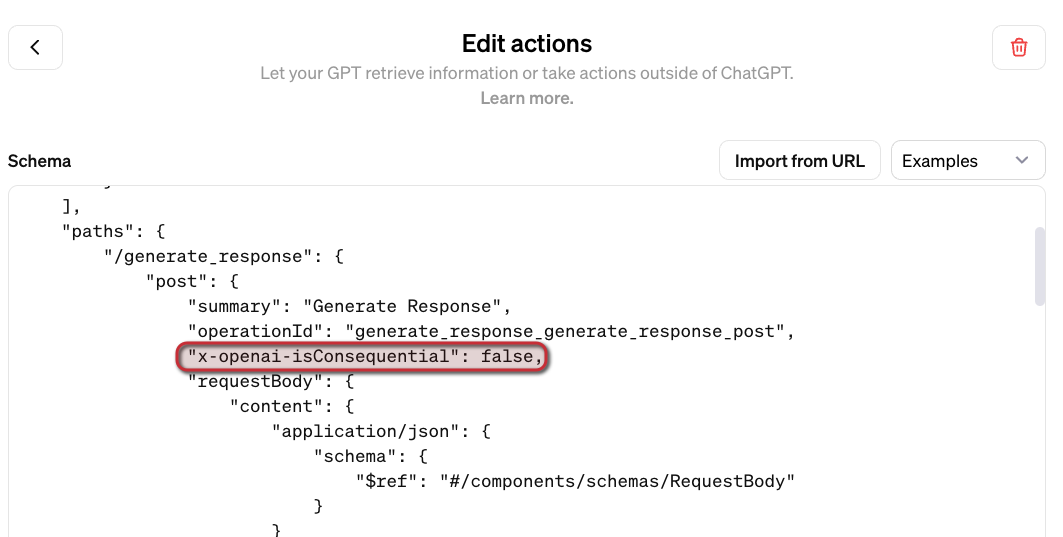
If you want to give the ability to the user to trust the action to be called without approval (after a first call), also add the following:

Allowing the user to say Always Allow when action is used the first time

Take a look at the video below that shows how to create the GPT, including the configuration of the action and testing it.

Conclusion

Custom GPTs in ChatGPT open up a world of possibilities to offer personalised ChatGPT experiences. With custom actions, you can let the GPT do anything you want. In this tutorial, the custom action is an API call that answers the user’s question using Azure OpenAI with Azure AI Search as the provider of relevant context.

As long as you build and host an API and have an OpenAPI spec for your API, the possibilities are virtually limitless.

Note that custom GPTs with actions are not available in the ChatGPT app on mobile yet (end November, 2023). When that happens, it will open up all these capabilities on the go, including enabling voice chat. Fun stuff! 😀

Trying the OpenAI Assistants API

If you have ever tried to build an AI assistant, you know that is not a simple task. In almost all cases, your assistant needs access to external knowledge such as documents or APIs. You might even want to provide your assistant a code sandbox to solve user queries with code. When your assistant is accessed via a chat application, you also have to implement chat history.

Although there are several frameworks like LangChain and Semantic Kernel that can help, OpenAI recently released the Assistants API. It is their own API, tied to their models. The primitives of an assistant are Assistants, Threads and Runs. Let’s start by creating an assistant.

Note: this post contains code snippets in Python. You can find the full example in this gist: https://gist.github.com/gbaeke/e6e88c0dc68af3aa4a89b1228012ae53

Note: although I except this API to become available in Azure OpenAI, I am not quite sure it will happen fast, if at all. So for now, try it out at OpenAI directly. It is still in beta!

Creating an assistant

You can create an assistant using the portal or from code. An assistant has several parameters:

  • Instructions: how should the assistant behave or respond; think of it as the system message
  • Model: use any supported model, including fine-tuned models; to support retrieval from documents, you need the 1106 version of gpt-3.5-turbo/gpt-4
  • Tools: currently, the API supports Code Interpreter and Retrieval; these are fully hosted by OpenAI
  • Functions: define custom functions to call to integrate with external APIs for instance

Note that the retrieval tool supports uploaded files. There is no need for your own search solution (e.g., vector database with support for vector search, hybrid search, etc…). This is great in simpler scenarios where a full-fledged search system is not required. More control over retrieval will come later.

In this post, we will focus on an assistant that uses Code Interpreter. You can simply create the assistant in the portal. You can see the instructions, model, tools and files:

Assistant with only the Code interpreter tool using the latest gpt-4 model

To create this assistant, make sure you have an account at https://platform.openai.com. Create the assistant from the Assistants section:

Creating an assistant

Assistants have an id. For example, my assistant has this id: asst_VljToh6vQ1Mbu6Ct5L6qgpfy. I can use this id in my code to start creating threads.

Before talking about threads, let’s look at creating the assistant with code:

assistant = client.beta.assistants.create(
                name="Math Tutor",
                instructions="You are a personal math tutor. Write and run code to answer math questions.",
                tools=[{"type": "code_interpreter"}],
                model="gpt-4-1106-preview"
  )

To run this code, make sure you use the most recent version of the openai package (>=1.2). Note that if you run this code multiple times, you will create an assistant at each run. You should save the assistant id after creation and implement some logic to only run the above code when you do not have an id.

Above, we create an assistant with one tool: code interpreter.

Threads

After creating an assistant, you can create threads. Although somewhat unintuitive, a thread is not associated with an assistant. They exist on their own. After a thread is created, you can add messages to a thread, for instance a user message:

# we use streamlit so we save the thread in session state
if 'thread' not in st.session_state:
        st.session_state.thread = client.beta.threads.create()

# user_input contains a quesion like 'solve x^2 + 100 =200'
# here we add a message to the thread, using the thread id
client.beta.threads.messages.create(
            thread_id=st.session_state.thread.id,
            role="user",
            content=user_input
 )

To get a completion from the assistant for our thread, we need to create a run. The run tells the assistant to look at the messages in the thread and provide a response.

Runs

Below, we create the run:

run = client.beta.threads.runs.create(
            thread_id=st.session_state.thread.id,
            assistant_id=st.session_state.assistant_id, # refer to assistant in session state
            instructions="Please address the user as Geert. Only answer math questions."
  )

Above, both the thread_id and assistant_id are passed to the run, tying both together. If you did not create the assistant in your code, ensure you pass the id of a valid assistant created in your OpenAI account. Note that the run can be passed extra instructions. You can also override the model and tools that the assistant uses.

Creating a run is an asynchronous operation. It returns the metadata of the run immediately. The metadata includes fields like the run’s id, the created_at date and more.

You will need to manually check the run’s status in your code. For example:

# display a streamlit spinner while we check the run
with st.spinner('Waiting for completion...'):
    run_status = 'pending'
    while run_status != 'completed':
        run = client.beta.threads.runs.retrieve(
            thread_id=st.session_state.thread.id,
            run_id=run.id
        )
        run_status = run.status
        
        if run_status == 'failed' or run_status == "cancelled":
            st.error("Run failed or cancelled")
            st.stop()

        time.sleep(0.5)

When the run is finished, we can retrieve messages:

messages = client.beta.threads.messages.list(
    thread_id=st.session_state.thread.id
)

The messages data field contains all messages. Each message has a role like user or assistant. Assistant messages can have different content, like text or image_file.

For example, if I ask Plot y=x^3 + 2x, there will be both text and image_file responses. It’s up to the developer to properly display them in the app. Below is a naive approach, which only works with text and image responses, not downloads (Code Interpreter can give download links):

try:
    # no support for file download yet, just text and image_file
    for message in messages.data:
        if message.role == 'user':
            st.markdown(f"**User:** {message.content[0].text.value}")
        if message.role == 'assistant':
            for content in message.content:
                if hasattr(content, 'text'):
                    st.markdown(f"**Assistant:** {content.text.value}")
                elif hasattr(content, 'image_file'):
                    # image Id = content.image_file.file_id
                    content = get_content(content.image_file.file_id)
                    image = Image.open(BytesIO(content))
                    st.image(image, caption="Downloaded Image", use_column_width=True)                    
except Exception as e:
    st.error(e)

The above should be pretty clear:

  • if the assistant responds with text, display the text
  • if the assistant responds with an image, there is an image Id; I use a get_content function to download the image from OpenIA; get_content also implements some straightforward caching logic to avoid having to download images over and over again in the same thread

The get_content function uses client.files.content(file_id).response.content to retrieve the file (client is OpenAI client). The returned result can be used by PIL to open the image and subsequently display it with Streamlit’s st.image:

Assistant in a Streamlit app

Note that I can keep asking questions, which adds messages to the same thread, based on the thread’s Id in Streamlit’s session state. When the user refreshes the browser, session state is cleared so a new thread is started. For example, when I ask change 2x in 3x:

Asking to change the function

In the code, I do not have to worry about chat history at all. I just add messages to the thread, which is managed by OpenAI. At the next run, all those messages are sent to the assistant’s model, which responds appropriately. Note that you do pay for the tokens that all those messages consume.

Conclusion

Compared to the synchronous and stateless ChatCompletion API, the Assistants API is asynchronous and stateful. As a developer, you create an assistant with tools, functions and content for retrieval purposes. Interacting with the assistant is easy: simply add messages to a thread and create a run.

Obviously, it is early days for this API as it is still in beta. Personally, I think it’s a great step forward, making it easier to create quite sophisticated assistants. Most orchestration frameworks and AI tools like LangChain, Semantic Kernel, Flowise, etc… already have support or will support assistants and will add extra capabilities or ease of use on top of the base functionality.